



Why Low FODMAP
Two out of three American adults deal with regular gas, bloating, or stomach pain, and most of them never mention it to a doctor. They're also mostly guessing at the cause, which is understandable given that in the same survey of 1,005 adults, half said they were confused by all the conflicting diet advice out there and six in ten didn't know that a food sensitivity and a food allergy are different things. When your stomach hurts and nobody has given you a real answer, you start cutting foods and hoping, and the food that usually goes first is bread.
It's probably not the gluten
If you have celiac disease then gluten really is the problem and none of this applies to you, and the same goes for a wheat allergy. Get tested before you change anything, because the tests only work if you're still eating gluten. For everyone else, though, the evidence says something different.
Researchers in Norway recruited 59 people who had already gone gluten-free on their own and felt better for it. Each person ate a muesli bar every day for a week, then switched, for three weeks total. One bar had gluten in it, about what you'd get from four slices of bread, one had fructan, a carbohydrate found in wheat but also in garlic and onion bulbs, and one had neither. Nobody knew which was which, not even the researchers, until it was over.
The fructan bar made people feel worse, while the gluten bar turned out to be no different from the bar with nothing in it. Out of 59 people convinced that gluten was their problem, only 13 had their worst week on gluten, and 27 of them actually had their best week on it.
A 2025 review in The Lancet reviewed all the good studies and reached the same conclusion: about 1 in 10 adults think they're sensitive to gluten, but when you test it properly only a small fraction actually are, which means that for most people something else in the food is doing it.
That's an expensive thing to get wrong. Gluten-free products cost 139% more than the regular versions, they take more time to cook, and they make eating out harder. Plenty of people pay all of that and still feel lousy, because they removed the wrong thing.
What's actually causing your gut troubles
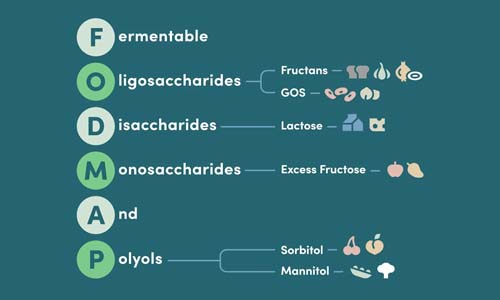
FODMAPs are a group of carbohydrates your small intestine has trouble absorbing. They pass through undigested, and then two things happen at once: bacteria ferment them into gas, and they pull water into your gut. That combination of gas and water creates pressure, and pressure is what you feel as bloating, cramping, and urgency.
None of this makes FODMAPs bad for you. They're in plenty of healthy food and they feed the good bacteria in your gut. Some guts just don't handle them well, and there are five groups to know about:
- Fructans: wheat, rye, barley, onion bulbs, garlic bulbs, chicory root, inulin
- GOS: beans, lentils, chickpeas, cashews
- Lactose: milk, soft cheese, yogurt
- Fructose: apples, pears, honey, high fructose corn syrup
- Polyols: stone fruit, avocado, mushrooms, sugar-free gum and mints
Look at that first group again, because wheat is a fructan and so are onion and garlic bulbs. Cutting bread takes out some of your fructans, which is often enough to feel a difference and conclude the gluten was the problem. It usually isn't enough to fix things, though, because the garlic and onion bulbs in nearly everything else you eat are still there.
That reads like bad news for anyone who cooks, but it isn't quite. Alliums keep their fructans down in the bulb, not in the green parts, so the flavor doesn't have to go with them. More on that further down.
Fructans are the one to go after first
Two recent studies added FODMAPs back one at a time, hidden inside identical food, to work out which ones were actually causing trouble.
A University of Michigan trial hid each FODMAP in brownies and found that fructans and GOS were the two that brought abdominal pain back, while lactose, fructose, and polyols didn't do much of anything. A larger Belgian study tested 117 people against six FODMAPs plus a dummy powder, and fructans set off symptoms in more people than any other group. Most of those patients had two or three triggers rather than all five, so your own list is probably short, and fructans are likely on it.
It works better than what most people try instead
If you take stomach trouble to a doctor, one of the common answers is rifaximin, an antibiotic approved for IBS. In the two big trials behind it, 41% of people got adequate relief compared with 32% on a placebo sugar pill, which is a pretty modest difference.
Eating lower FODMAP performs way better than that. Across ten-plus controlled trials, somewhere between 50% and 80% of people with IBS improve on a low FODMAP diet, and results outside of trials are around 70%.
And when researchers compared diet and medication directly in the same study, the diet did better. The DOMINO trial gave 459 patients either an antispasmodic drug or a phone app that lowered FODMAPs, and after eight weeks 71% had improved on the diet versus 61% on the drug. People stuck with the diet, too, at 94% adherence compared with 73% for the pills, which led the researchers to conclude that diet should be the first thing primary care doctors try. The diet arm wasn't a rigid elimination protocol or months of label reading, just an app that lowered FODMAPs while still letting people eat.
Only the first phase is temporary
The low FODMAP diet has three parts that people tend to blur together:
- Cut back for two to six weeks and see if you feel better
- Add things back one group at a time to find your actual triggers
- Settle into your own version and stay there
Only the first step is meant to be temporary. Strict elimination is a short diagnostic exercise, while eating lower FODMAP, in whatever personalized version you end up with, is something you stay on. That part works over the long term. Researchers followed IBS patients for twelve months on a personalized low FODMAP diet and the share reporting good symptom relief rose from 28% to 67%. Their bifidobacteria, the good gut bacteria everyone worries about losing, sat at normal levels, because by then they'd added fructans and GOS back in the amounts they could handle.
What you don't want is to live in step one forever, since staying in strict elimination does thin out those bacteria, and turns every meal into a worry. Researchers have been developing gentler versions for that reason: one approach trims just the handful of foods highest in FODMAPs and goes further only if you need it to, and another cuts only fructans and GOS while leaving the rest alone. In a small trial that simpler version worked about as well as the full diet and was easier to stick with.
The rule underneath all of them is to swap rather than subtract, because every gentler version works by replacing high FODMAP foods with low FODMAP versions of the same thing instead of leaving you with less to eat. If you're already eating gluten-free because of your stomach, you've already shown you'll change how you eat to feel better. The evidence just says you were probably one ingredient off.
Which brings us to garlic and onion (the bulbs, anyway)
This is where most low FODMAP advice causes deep agita (and rightly so!), because garlic and onion are the base of nearly every savory dish we all eat. Take them out and food feels flat, your recipes stop working, and eventually you quit. People don't abandon this diet because it stopped working, they quit because dinner got sad.
The plants solve this themselves. Alliums store their fructans in the bulb, and the green parts contain far less of them, which is why clinical food guides list chives and scallion greens as direct swaps for onion and leek. So you don't actually have to give up the onion and garlic family, you just have to limit the bulbs.
This is what all the Gourmend products do, using garlic scapes, garlic chives, and the green tops of scallions and leeks in powders and broths that give you the flavor and go easier on your gut.
- Garlic Scape Powder and Garlic Chive Powder in place of garlic powder
- Green Onion Powder in place of onion powder
- Garlic Chive Salt and Green Onion Salt for finishing
- Taco Seasoning built without the bulbs
- Chicken, beef, and vegetable broths made with green leek and scallion tops instead of the onion and garlic bulbs in every other stock on the shelf
All of our products are certified low FODMAP by FODMAP Friendly, USDA Organic, and made by a Certified B Corporation. We go after fructans because the research points to them as a trigger more often than any other group, and because they cost you the most flavor when they're gone.
Where to start
Rule out celiac disease first, while you're still eating gluten, which takes a blood test and a conversation with your doctor.
Then try limiting fructans. Pull garlic bulbs, onion bulbs, and wheat for two to four weeks and pay attention to what happens. If you feel a lot better, you'll have your answer.
Replace as you go, swapping in garlic scape powder for garlic powder, green onion powder for onion powder, low FODMAP broth for the usual, and sourdough for standard bread (the proofing process reduces the fructan level in the wheat, which makes it easier to digest). If you'd rather start with one box, the bundles cover the swaps you'll need the most.
Then add things back, one at a time, keeping notes as you go, since you're trying to end up with the shortest possible list of things to avoid rather than the longest. Our complete guide walks through how to run the reintroductions, and we also keep a list of low FODMAP ingredients covering every aisle of the store.
Get help if you can, because a dietitian trained in this will get you through it faster and with fewer unnecessary restrictions than you'd manage on your own, and we keep a directory of low FODMAP dietitians to make that easier.
The goal was never to eat less. It's to find the two or three things that actually bother you, build a way of eating around that, and stop thinking about the rest.
This is general information, not medical advice. Talk to your doctor or a registered dietitian about your own symptoms.
Sources
- Skodje GI, et al. Fructan, Rather Than Gluten, Induces Symptoms in Patients With Self-Reported Non-Celiac Gluten Sensitivity. Gastroenterology. 2018;154(3):529-539.
- Biesiekierski JR, Jonkers D, Ciacci C, Aziz I. Non-coeliac gluten sensitivity. The Lancet. October 2025.
- Staudacher HM, Whelan K. The low FODMAP diet: recent advances in understanding its mechanisms and efficacy in IBS. Gut. 2017;66(8):1517-1527.
- Eswaran S, et al. All FODMAPs Aren't Created Equal. Clin Gastroenterol Hepatol. 2025;23(2):351-358.
- Van den Houte K, et al. Efficacy and Findings of a Blinded Randomized Reintroduction Phase for the Low FODMAP Diet in IBS. Gastroenterology. 2024;167(2):333-342.
- Singh P, et al. Is a Simplified, Less Restrictive Low FODMAP Diet Possible? Clin Gastroenterol Hepatol. 2025;23(2):362-364.
- Pimentel M, et al. Rifaximin Therapy for Patients with IBS without Constipation. N Engl J Med. 2011;364(1):22-32.
- Carbone F, et al. Diet or medication in primary care patients with IBS: the DOMINO study. Gut. 2022;71(11):2226-2232.
- Halmos EP, Gibson PR. Controversies and reality of the FODMAP diet for patients with IBS. J Gastroenterol Hepatol. 2019;34(7):1134-1142.
- Staudacher HM, et al. Long-term personalized low FODMAP diet improves symptoms and maintains luminal Bifidobacteria abundance in irritable bowel syndrome. Neurogastroenterol Motil. 2022;34(4):e14241.
- Wilson B, et al. β-Galactooligosaccharide in Conjunction With Low FODMAP Diet Improves IBS Symptoms but Reduces Fecal Bifidobacteria. Am J Gastroenterol. 2020.
- MDVIP/Ipsos Gut Health Survey, May 2023.