


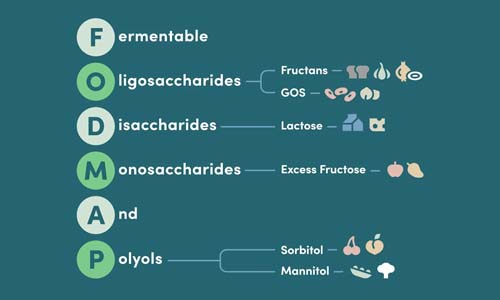

This is the ultimate guide to low-FODMAP eating and cooking. In this guide, you’ll learn:
- The basics of FODMAPs, including the foods that FODMAP-sensitive individuals should avoid
- How to prepare and eat meals that are nutritious and delicious after eliminating garlic, onions, and other ingredients from your diet
- The basics of smart shopping and flavorful cooking with low-FODMAP ingredients
If you're ready to learn how to follow a low-FODMAP diet for improved gut health, then you need to read this guide.
Let’s get started!

A diet that restricts high-FODMAP foods has been shown to reduce gastrointestinal symptoms in people with irritable bowel syndrome (IBS)1. In people whose inflammatory bowel disease (IBD) is in remission but who still have IBS-type gut symptoms, it can reduce those symptoms too2 (Cox et al., Gastroenterology 2020) — but it does not treat IBD itself and is not a substitute for IBD medical therapy. In fact, research asserts that 50-80% of IBS sufferers that followed a diet low in FODMAPs found relief from their symptoms1. More recent and larger: the DOMINO trial in primary care put 459 people with IBS on either a low-FODMAP diet or a standard antispasmodic. 71% improved on the diet against 61% on the drug, and 94% stuck with the diet versus 73% with the medication — the authors concluded diet should be the first thing primary care tries (Carbone et al., Gut 2022). For comparison, the antibiotic rifaximin helps about 41% of people against 32% on placebo (Pimentel et al., NEJM 2011).
The information in this guide is not intended to replace medical treatment and counsel that your health care provider offers. It is intended to educate and supplement personalized medical advice, while providing support at all stages of the low-FODMAP diet experience. Keep in mind that we offer these resources and suggestions for support, education and guidance only. Use them to complement consultations with a registered dietitian.











Part 1 FODMAP Basics
What does FODMAP stand for?
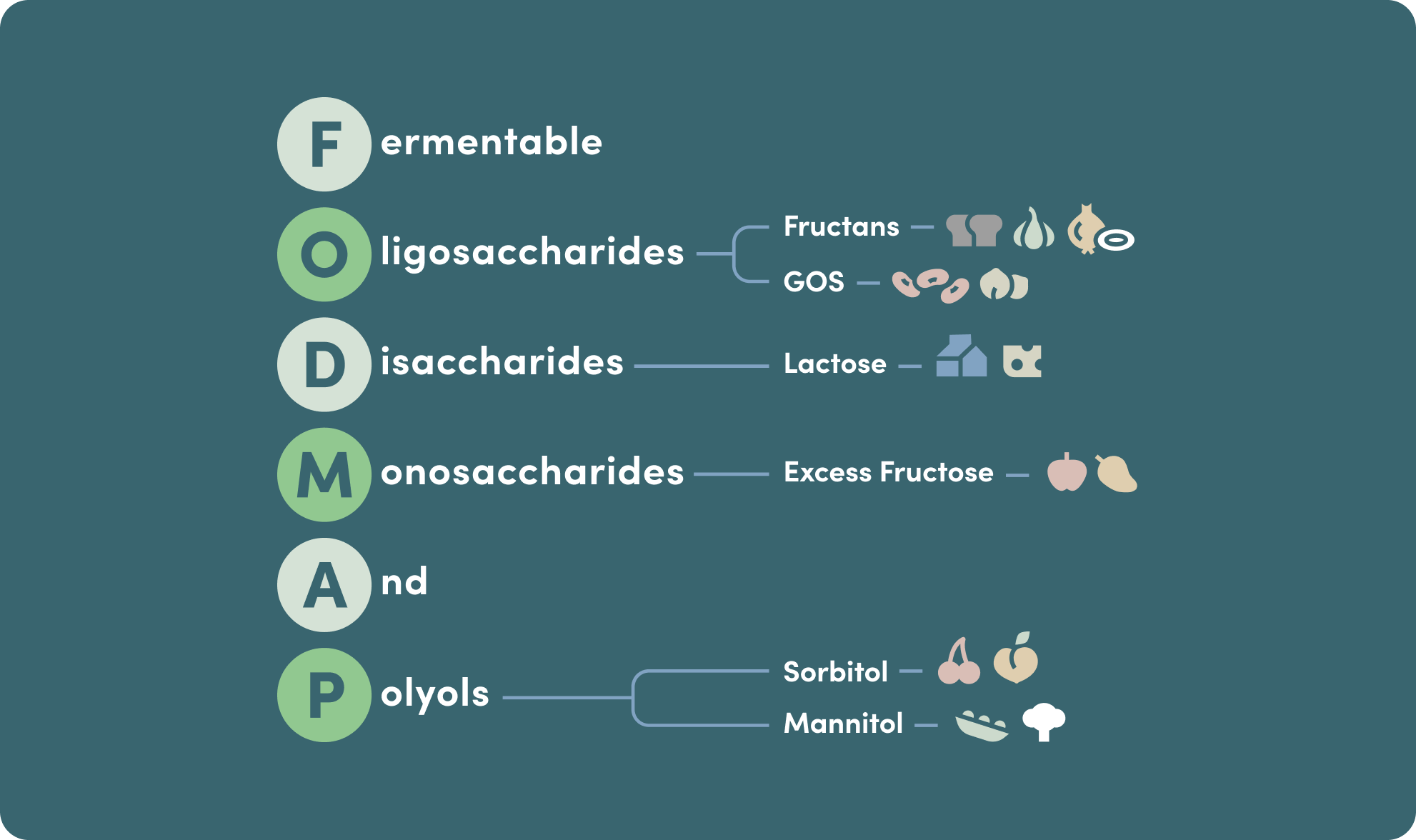
FODMAP stands for F ermentable O ligosaccharides, D isaccharides, M onosaccharides and P olyols. These are short chain carbohydrates that are poorly absorbed in the small intestine, making them difficult to digest for many individuals.3
Found in many of the foods we eat every day, FODMAPs are not inherently unhealthy, so what makes them so troublesome to those with IBS or other digestive conditions?

FODMAPs are fermented in your gut during digestion, but if this happens too fast, abdominal cramps and other symptoms may occur.

During digestion, FODMAPs can draw excess water into the intestine, leading to stomach pain, diarrhea, and bloating.
Whether one or more of these FODMAP characteristics are at play will depend upon on the amount consumed and an individual's degree of intolerance of the carbohydrates.
It’s important to work with a registered dietitian — ideally one trained in FODMAPs — if you suspect that you have a FODMAP sensitivity.
Here’s why:
- Your dietitian can help you understand common FODMAPs like fructose and lactose
- They can assist you in determining your level of FODMAP tolerance
- They can help ensure you are getting necessary nutrients while limiting your intake of high-FODMAP foods
Rule out celiac disease first — while you’re still eating gluten. Celiac disease and IBS share symptoms, and the blood test and biopsy only work if gluten is still in your diet. Cutting wheat as part of a low-FODMAP trial can mask a result you needed. Ask your doctor for the test before you start eliminating anything.
The most common FODMAPs include:
Oligosaccharides
Oligosaccharides are found in asparagus, beans, onions, garlic, and other food ingredients present in many American diets.
Fructans
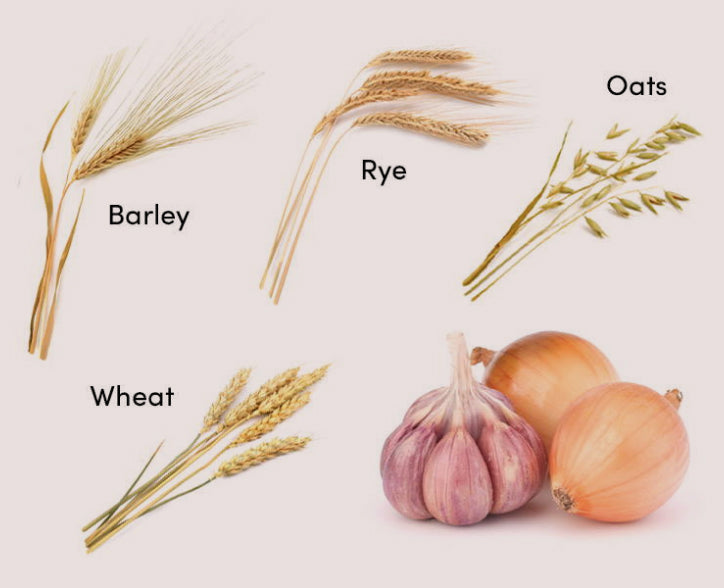
Fructans, including barley, rye, wheat, asparagus, garlic and onions, are oligosaccharides. Some individuals with chronic digestive disorders may not digest them properly. They reach the large intestine undigested and are fermented by the guts beneficial bacteria.
Some fructans, such as inulin and chicory root, are often added to foods to give it more texture and fiber. These can add to digestive distress and it is important to look for these on a food label as it can increase the FODMAP content of a packaged food significantly.
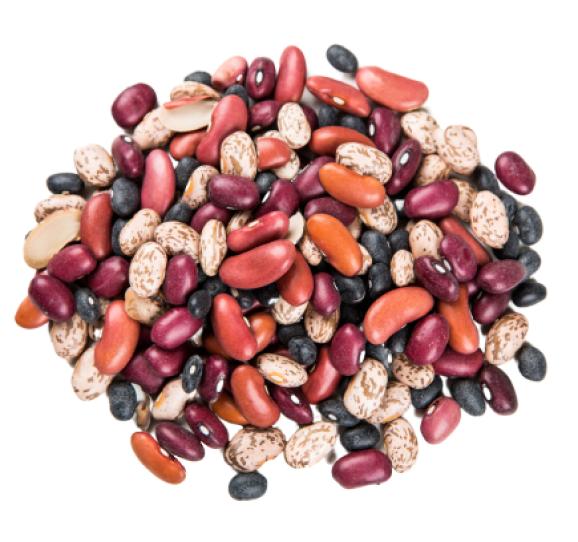
Galactooligosaccharides (GOS)
A GOS is an oligosaccharide that is malabsorbed by everyone’s body to some extent, as our intestines lack the enzyme needed to break it down. When GOS' are fermented by the gut’s beneficial bacteria, gas is produced.
Individuals with IBS are often more sensitive to this reaction, experiencing stomach pain among other symptoms. High levels of GOS are found in legumes, so a diet that limits beans is often beneficial for those with a FODMAP sensitivity.
Disaccharides
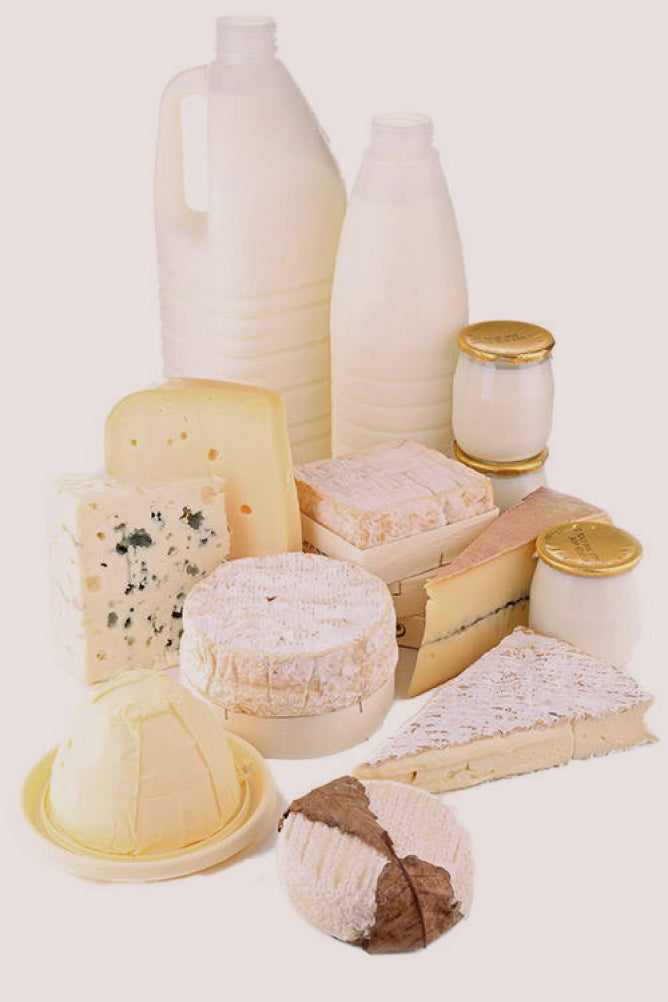
Disaccharides are double sugars. Only one of them is a FODMAP: lactose, found in milk, soft cheese and yogurt.
Lactose
A sugar composed of glucose and galactose, lactose is a disaccharide found in milk, curds, whey, dry milk solids, and other dairy products. The small intestine must produce sufficient amounts of the enzyme lactase in order to effectively digest lactose sugar.
If the body fails to produce enough lactase to digest lactose properly, then lactose intolerance will occur. Gastrointestinal distress can occur between 30 minutes to two hours after certain dairy products are consumed.4
There are several products that contain lactase which may help you better digest lactose. Available from most pharmacies, lactase tablets or drops are an enzyme supplement that may be helpful to some people who are lactose intolerant. Note that some of these supplements contain mannitol and other high-FODMAP polyols. Be sure to check the label and select a brand that is low FODMAP.
Monosaccharides
Monosaccharides are the simplest form of sugar and the most basic units of carbohydrates. The most common monosaccharide is fructose.
Fructose (in excess of glucose)
This monosaccharide is naturally found in honey, vine and tree fruits, asparagus and artichokes. Commercially, fructose is gleaned from maize, sugar cane, and sugar beets.
Often, this fruit sugar is added to food and drinks to enhance the taste. Additionally, fructose and glucose monosaccharides are combined to create high-fructose corn syrup.
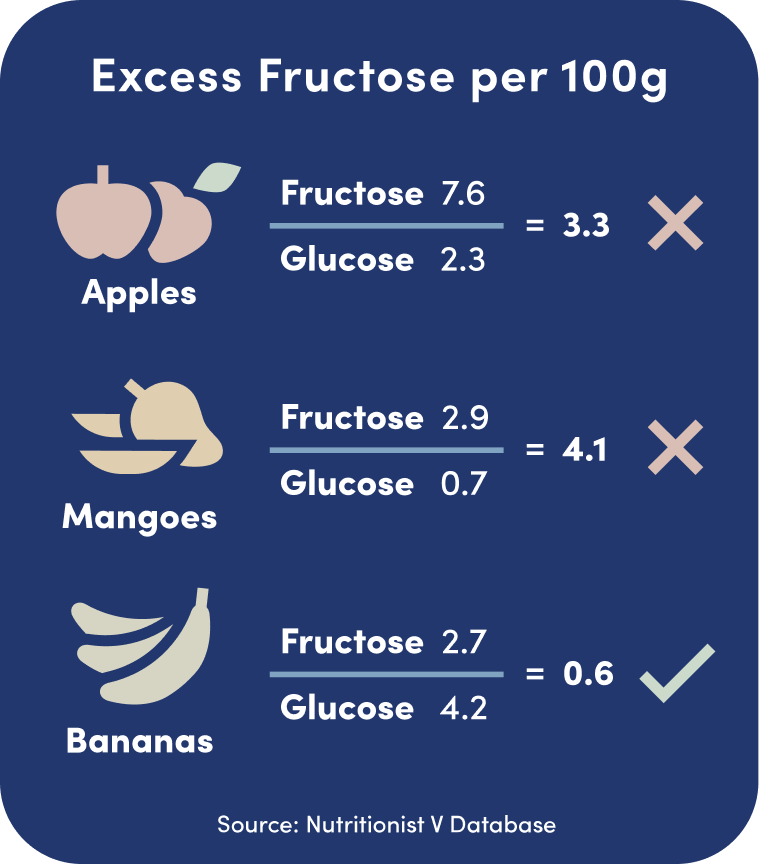
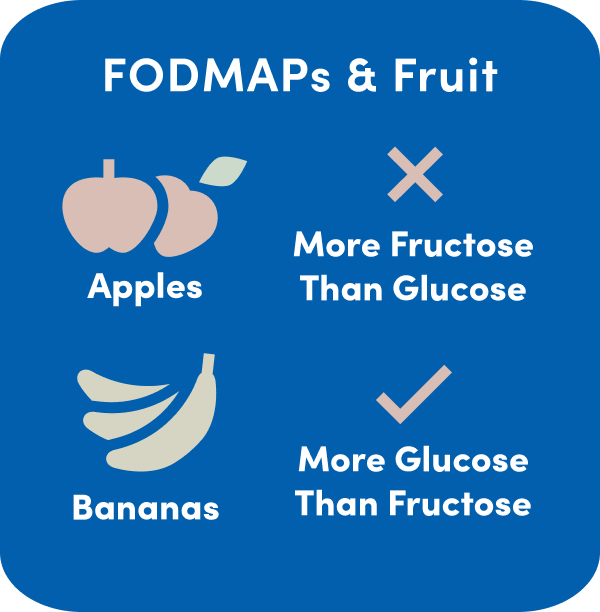
Food containing fructose is considered low FODMAP if it has a less or equal level of fructose than glucose (like an unripe banana). Food that has more fructose than glucose (like an apple) is considered high FODMAP and is associated with digestive issues that occur when the body is unable to efficiently break down the sugar.
And Polyols
Polyols are found naturally in fruits and vegetables, and are frequently used as sweeteners in cough drops, medications, mints, and sugar-free gum.
When sugar polyols reach the large intestine for fermentation, these FODMAPs are frequently malabsorbed. The sugar polyols can pull water through the bowel or be fermented by intestinal bacteria, and these changes often result in discomfort.
The severity of symptoms will depend on the amount of polyols consumed, what other FODMAPs have been eaten that day, and if the gut was already in a sensitive state before introducing the polyols. The two most common polyols are:
Sorbitol
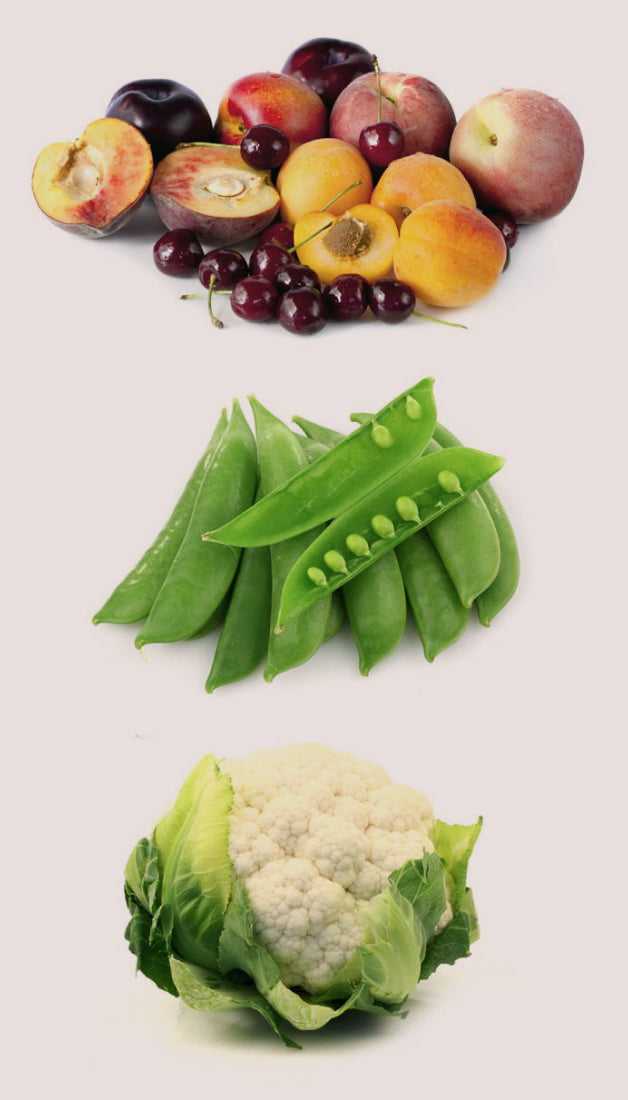
Sorbitols occur naturally in apricots, blackberries, cherries, nectarines, peaches, plums and prunes. (Cherries also carry excess fructose, and nectarines fructans — worth knowing if you’re running a sorbitol challenge.)
Mannitol
If you’re sensitive to mannitol, watch celery, clingstone peaches, button mushrooms and snow peas (snow peas also carry fructans). Watermelon is often listed here too, but its high rating comes mainly from excess fructose and fructans, so it isn’t a clean mannitol test.
Which FODMAPs actually cause the trouble?
Not all five groups pull equal weight. Two studies put this to the test by adding FODMAPs back one at a time inside otherwise identical food. In a University of Michigan trial using brownies, fructans and GOS brought pain back while lactose, fructose and polyols did little (Eswaran et al., Clin Gastroenterol Hepatol 2025). In a Belgian study of 117 patients, fructans set off symptoms in more people than any other group (Van den Houte et al., Gastroenterology 2024). Most people had two or three triggers, not five.
The practical consequence: your list is probably short, and fructans are probably on it. That reframes the whole diet from “eliminate everything” to “start with the one that’s most likely” — which is why this guide spends a whole part on onion and garlic. The full argument is on our Why Low FODMAP page.
Part 2 Elimination, Reintroduction & Personalization
Following the low-FODMAP diet will help you understand the ways that different types of foods may act as a trigger for symptoms of IBS and overall digestive distress.
Your body’s reaction to FODMAPs will depend upon the type and amount you consume and your degree of intolerance to that fermentable carbohydrate.
This diet isn’t for everyone. A low-FODMAP diet is not appropriate if you have a current or past eating disorder, ARFID (avoidant/restrictive food intake disorder), significant food fear or anxiety around eating, if you’re underweight or nutritionally compromised, or if you’re food insecure. Restriction can make all of those worse. If any of that describes you, talk to your doctor or a registered dietitian before cutting anything out — gentler approaches exist; see “Gentler ways in” under Step 1 below. The American Gastroenterological Association’s 2022 guidance puts screening for disordered eating ahead of starting the diet.
Step 1: Adhere to a Low-FODMAP Diet for 2-6 Weeks
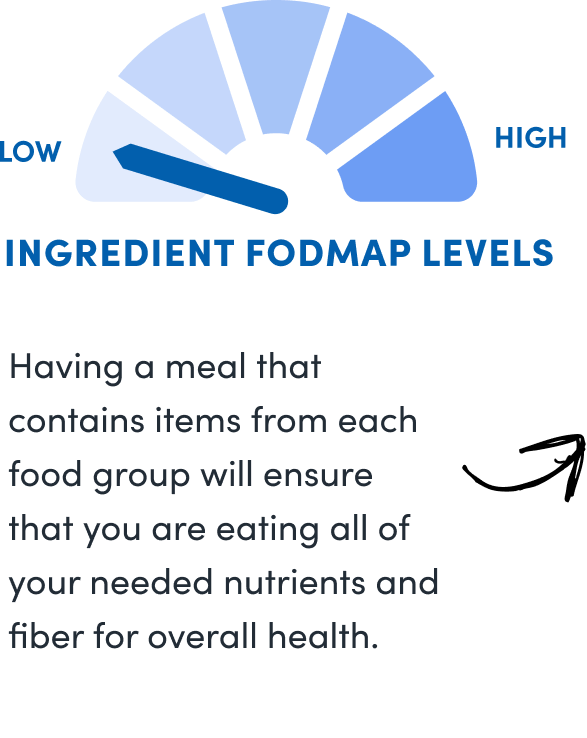
In this step, you should follow a diet that consists of balanced meals containing a variety of low-FODMAP foods within this format:
- Proteins: 5-6 ounces per day (a serving is: 1 ounce of fish, chicken, lean meats, firm tofu, 1 egg, ½ ounce of allowable nuts and seeds, ¼ cup of allowable beans)
- Whole grains and bread: 6-7 servings per day (a serving is 1 slice of gluten free bread, ½ cup of cooked grain (rice, quinoa) or gluten free pasta, 5 gluten free crackers or 1 small corn tortilla).
- Fruits: 2-3 servings per day (a serving is 1 medium whole fruit or 1 cup diced).
- Vegetables: 3-5 servings per day (a serving is ½ cup cooked or 1 cup raw).
- Dairy: 2 - 3 servings of dairy per day (a serving is 1 cup of lactose-free milk or allowable non-dairy milk fortified with calcium and vitamin D, 1 cup of plain lactose-free yogurt or 1 ounce of aged cheese).
- Healthy fats: When possible, choose olive oil for cooking and for dressings.
The FODMAP content can vary among foods. It can be higher depending on the serving size and or ripeness. For example:
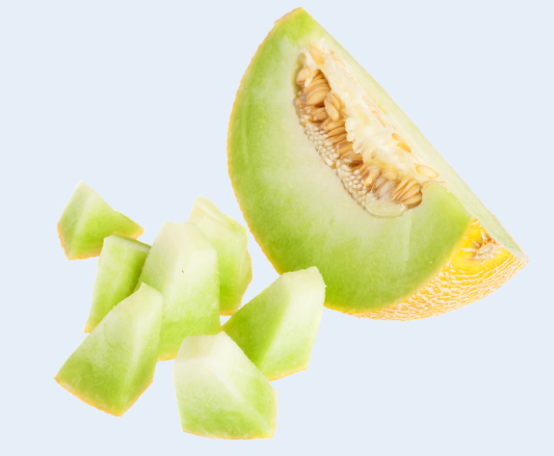
A honeydew melon is low FODMAP when eaten as a ½ cup serving, a moderate-FODMAP fruit at 2/3 of a cup and a high-FODMAP fruit at a 1 cup serving.

Bananas are low FODMAP when they are unripe and high FODMAP when they are ripe (when they have many brown spots).
*For specifics on quantities for most ingredients, keep reading and also check out the Monash University Low FODMAP app.
Here is an example of a low-FODMAP day, by meal:
Breakfast
- ½ cup dry rolled oats (52 g), cooked
- 1 tablespoon (20 ml) 100% pure maple syrup
- ¾ cup (200 ml) rice milk, or 1 cup lactose-free milk
- ⅓ medium ripe banana (35 g), or a whole firm one
- 1 hard-boiled egg
- ½ cup black coffee
Morning Snack
- 2 tablespoons peanut butter
2 brown rice cakes
Lunch
- 3 oz grilled chicken breast with olive oil over a bed of arugula lettuce and 65 g of sliced tomato (about half a medium tomato)
- 1 cup cooked quinoa, made with low FODMAP broth or water
- 15 string beans (75 g), cooked
- 1-2 tablespoons olive oil, lemon juice, salt and pepper
Afternoon Snack
- 4 oz plain lactose-free yogurt
- ⅓ cup raspberries (60 g)
Dinner
- 4 oz baked fish with lemon, herbs and olive oil
- 1 medium baked potato
- 1 teaspoon butter
- 1 cup sautéed kale in olive oil
Fluids
- Drink plenty of water.
Do your best to adhere to low-FODMAP portion sizes during the Elimination Phase, but allow yourself slight variations without added stress. Success will be achieved with careful planning and accurate information. Please note that:
- The Elimination Phase can take from 2 to 6 weeks to see a change in symptoms.
- If your symptoms have significantly decreased after 2 weeks, you can proceed to the Reintroduction Phase. Some people will need longer than others and this is normal as each person is different and has varying times to meet their goals.
- If after 6 weeks you have not seen a significant difference, stop the diet and reassess with a clinician — don’t keep restricting while you wait for an appointment. The American Gastroenterological Association’s guidance is that a diet trial should run a set length and then be abandoned for another treatment if there is no clinical response; there may be a cause outside of diet.
Gentler ways in
Full elimination isn’t the only route, and for some people it isn’t the right one. Two lighter versions exist. FODMAP Gentle, from Monash, restricts only the foods highest in FODMAPs rather than everything with any. FODMAP Simple cuts just fructans and GOS — the two groups most likely to be the problem (see Part 1). The evidence for both is pilot-level rather than first-line, and Monash is explicit about who they suit: mild symptoms, children and older adults, anyone nutritionally compromised or already on a restricted diet (gluten-free, for instance), people with limited cooking time or ability, and anyone at risk of disordered eating (Monash). FODMAP Simple was tested in a double-blind pilot trial (Singh et al., Clin Gastroenterol Hepatol 2025).
Whichever version you choose, swap rather than subtract. Every gentler approach works the same way: it replaces a high-FODMAP food with a low-FODMAP version of the same thing — leek and scallion tops for onion, garlic scape for garlic, lactose-free milk for milk — instead of leaving you with less to eat. That’s also the honest reason people quit the diet: not because it didn’t work, but because dinner got sad.
Step 2: Reintroduce FODMAPs Back Into Your Diet
This is where we can discover the most important information about your digestion: which FODMAPs cause you to have increased symptoms and how much of it acts as a trigger.
- This phase can help you find out how food may affect you and how to have the least restrictive diet with your new knowledge. It is possible that your digestion can change over the years and you may need to re-challenge foods again.
- The Reintroduction Phase usually takes 8 to 12 weeks or more: around ten challenges, each followed by a washout. Start with one FODMAP group at a time and test one food in a gradual increase to a typical serving size over three days. Then return to strict low FODMAP for about three days before the next challenge, whether or not you had symptoms — that washout is what keeps one test from bleeding into the next. This is a time where you may want to journal your experience and see what does and does not cause symptoms.
- Once you have trialed one FODMAP group, begin eliminating foods from that group again and go on to the next group to test. This is to isolate one group at a time for best observations.
Here is an example of how to conduct a "reintroduction" (you are welcome to do this in any order that you like and/or choose different challenge ingredients).
Oligosaccharides (Fructans & GOS)
Select a food from the Fructan group and add to a meal every day for three days in a row. Then, do the same with a food from the GOS group.
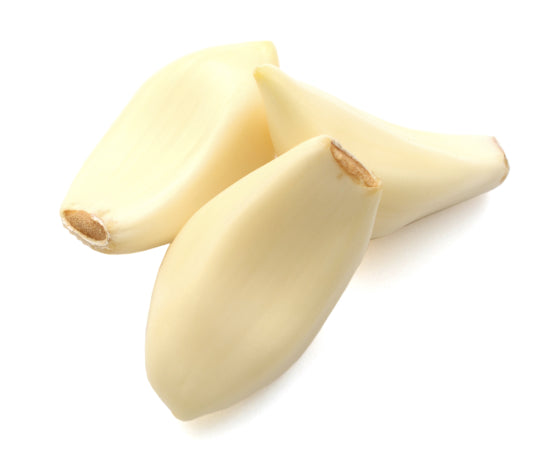
Fructan Group Challenge: Using Garlic
Note: Fructans are challenged as several separate foods, not one group — people often react to garlic but not to other fructan sources. Test wheat (your own regular bread, then wheat pasta or couscous), garlic, onion, and a fructan fruit or vegetable individually.
- Day 1: ¼ clove of garlic
- Day 2: ½ clove of garlic
- Day 3: 1 clove of garlic
- Later on Day 3: Any symptoms? If yes, then you are intolerant to fructans and should be cautious when eating foods in that group. If no, then you can continue to enjoy foods containing fructans in your regular diet, once all FODMAP groups have been challenged.
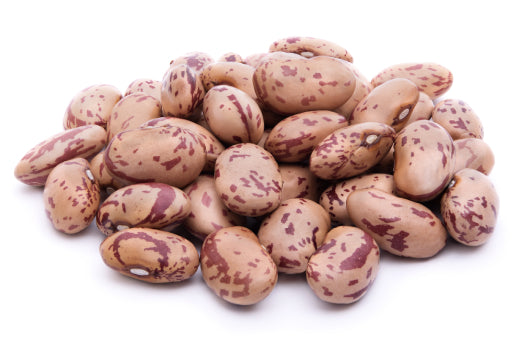
GOS Group Challenge: Using Pinto Beans
- Day 1: ¼ cup of pinto beans
- Day 2: ½ cup of pinto beans
- Day 3: 1 cup of pinto beans
- Later on Day 3: Any symptoms? If yes, then you are intolerant to GOS and should be cautious when eating foods in that group. If no, then you can continue to enjoy foods containing GOS in your regular diet, once all FODMAP groups have been challenged.
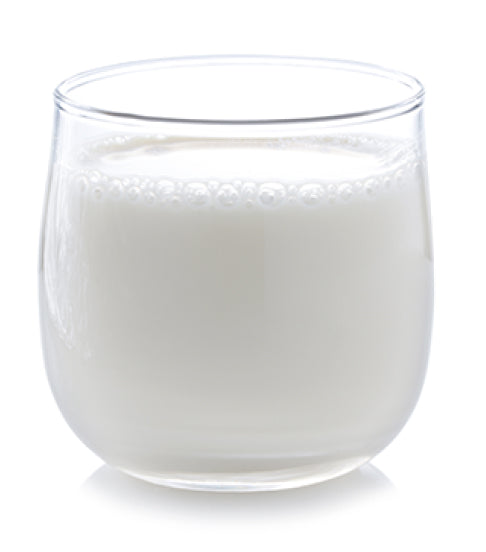
Disaccharides (Lactose)
Select a food in the Lactose group and add to a meal every day for three days in a row.
Lactose Group Challenge: Using Regular Cow’s Milk
- Day 1: ¼ cup regular cow’s milk
- Day 2: ½ cup regular cow’s milk
- Day 3: 1 cup regular cow’s milk
- Later on Day 3: Any symptoms? If yes, then you are intolerant to lactose and should be cautious when eating foods in that group. If no, then you can continue to enjoy foods containing lactose in your regular diet, once all FODMAP groups have been challenged.
Monosaccharides (Fructose)
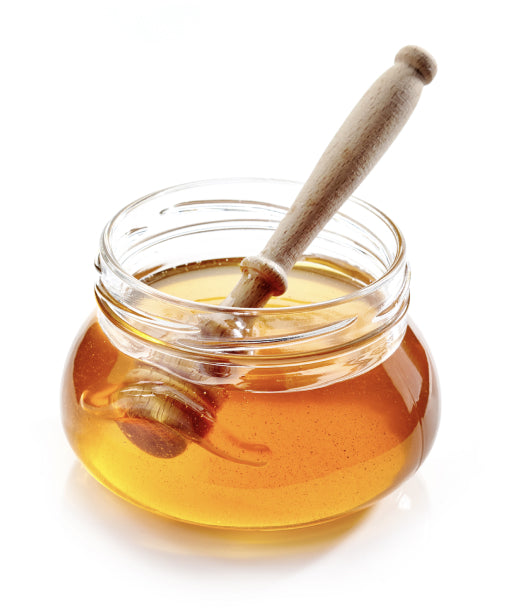
Select a food in the Fructose group and add to a meal every day for three days in a row.
Fructose Group Challenge: Using Honey
- Day 1: ½ tablespoon honey
- Day 2: ¾ tablespoon honey
- Day 3: 1 tablespoon honey
- Later on Day 3: Any symptoms? If yes, then you are intolerant to fructose and should be cautious when eating foods in that group. If no, then you can continue to enjoy foods containing fructose in your regular diet, once all FODMAP groups have been challenged.
Polyols (Mannitol & Sorbitol)
Select a food from the Mannitol group and add to a meal every day for three days in a row. Then, do the same with a food from the Sorbitol group.
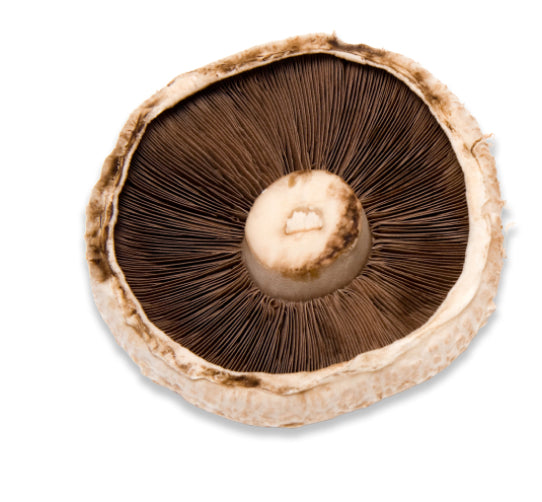
Mannitol Group Challenge: Using a Portobello Mushroom
- Day 1: ⅓ of a cooked Portobello mushroom added to dinner
- Day 2: ½ of a Portobello mushroom
- Day 3: 1 Portobello mushroom
- Later on Day 3: Check in with yourself to see if you have increased symptoms. If yes, then you are intolerant to mannitol and should be cautious when eating foods in that group. If no, then you can continue to enjoy foods from that group in your regular diet, once all FODMAP groups have been challenged.
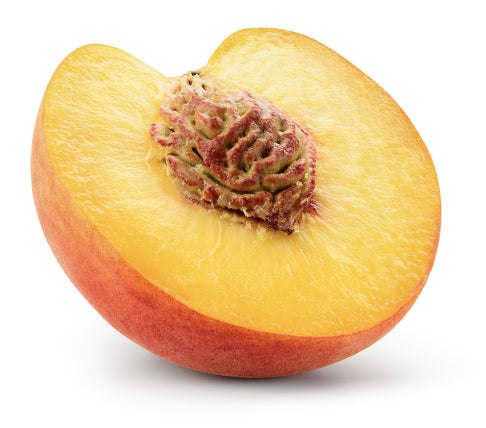
Sorbitol Group Challenge: Using a Yellow Peach
- Day 1: ⅓ a cup of yellow peach
- Day 2: ⅔ cup of yellow peach
- Day 3: 1 medium yellow peach
- Later on Day 3: Any symptoms? If yes, then you are intolerant to sorbitol and should be cautious when eating foods in that group. If no, then you can continue to enjoy foods from that group in your regular diet, once all FODMAP groups have been challenged.
If at any time during the Reintroduction Phase, you begin to experience immediate symptoms and become uncomfortable, stop the challenge. Return to a strict low-FODMAP diet and give your body a rest for three days or until symptoms subside. Then you may start the next challenge.
Learning what your FODMAP triggers are can be very empowering. There is peace of mind that comes with having the information you need to best plan meals and the explanation you've wanted for why you may experience stomach trouble when eating certain foods.
Step 3: Personalize Your FODMAP Diet
- After you have challenged your FODMAP groups and determined which are your trigger foods, simply return to your regular diet and avoid those that you were sensitive to. For example, if garlic is your trigger, use garlic infused oils or garlic scape powder to flavor your recipes. If honey is your trigger, you can simply use 100% maple syrup in its place.
- Remember to follow a balanced meal plan that contains all the food groups and is adequate in fiber for good nutrition and optimal bowel health.

Part 3 Onion, Garlic, and the Low-FODMAP Diet
In this chapter, we'll explain:
- What makes onion and garlic high-FODMAP foods
- If and when these can be consumed
- How to cook flavorful meals without using onion and garlic
Onions
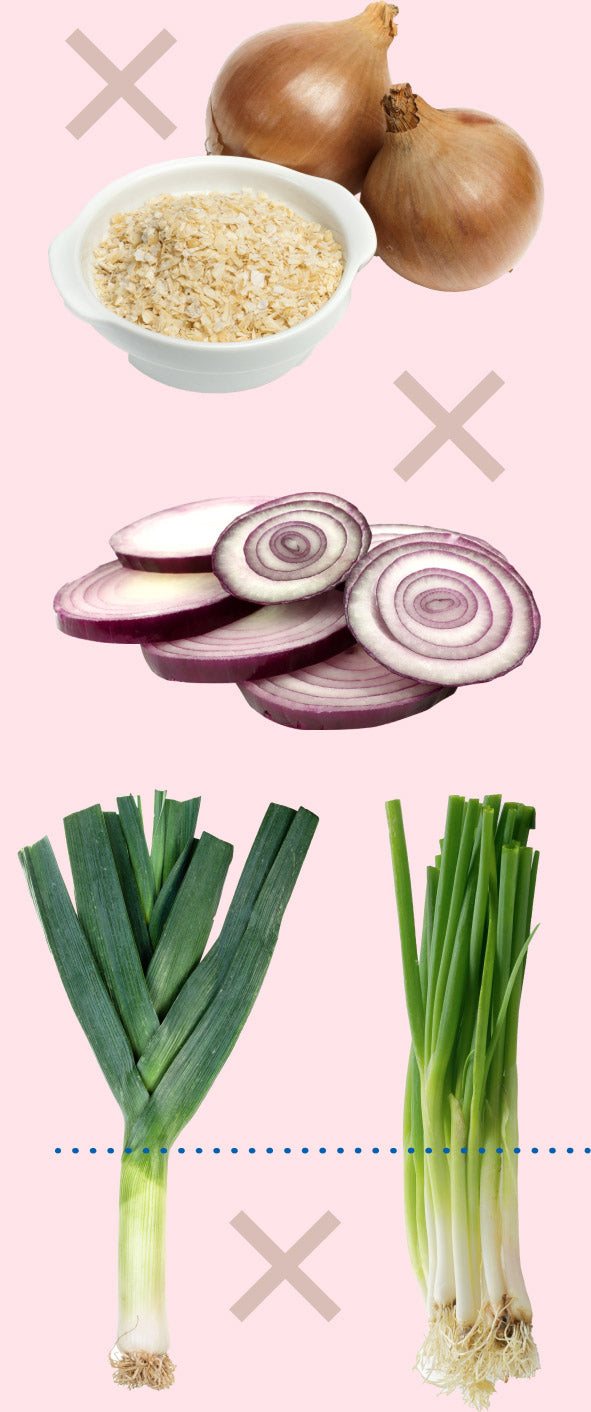
All onions are considered high-FODMAP, and therefore have the potential to cause digestive distress.
Onions are a concentrated source of fructans, and it may be a difficult food to avoid while adhering to the low-FODMAP diet, as the bulb is frequently used to flavor an array of dishes.
The FODMAP content in onions can vary depending on the type of onion. One of the lowest concentrations of fructans is in Spanish onions, while shallots contain among the highest.
Unless you have found that fructans are not a problematic FODMAP for you, eliminate all onions while on the low-FODMAP diet.
This includes standard onions as well as:
- Shallots
- Onion powder
- Pickled onions
- The white bottoms of leeks and scallions
- Seasonings flavored with onion (in general, avoid spice mixes and blends, as dried garlic and onion are common ingredients in these).
Garlic
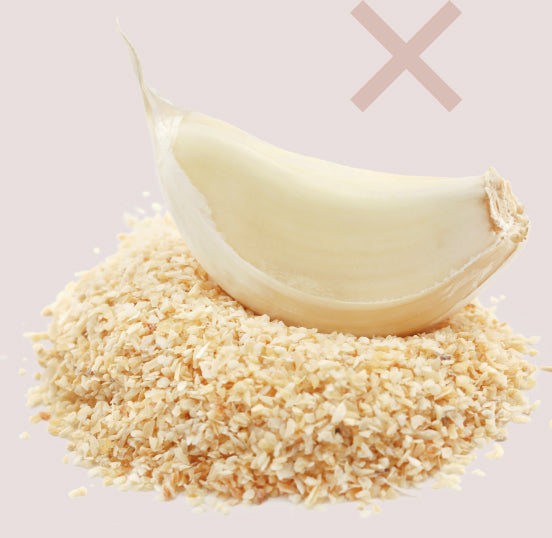
Like onions, fresh and dried garlic contain some of the most concentrated sources of FODMAPs. Fructans are the primary FODMAP type found in garlic.
Unless you have found that fructans are not a problematic FODMAP for you, eliminate all garlic while on the low-FODMAP diet.
Limiting garlic in your diet is especially challenging, as the food is commonly added to flavorings, broths, spice mixes, sauces, and gravies.
Despite being high in FODMAPs, garlic is gluten-free, and is associated with many health benefits.5 If you have successfully reintroduced garlic back into your diet and no intolerance is noted, feel free to include it in your diet.
4 ways to cook flavorful meals without consuming onion and garlic:
If your favorite home-cooked dish calls for garlic and onion, you don’t have to banish those flavors from your dinner table forever!
#1
Use Garlic Substitutes
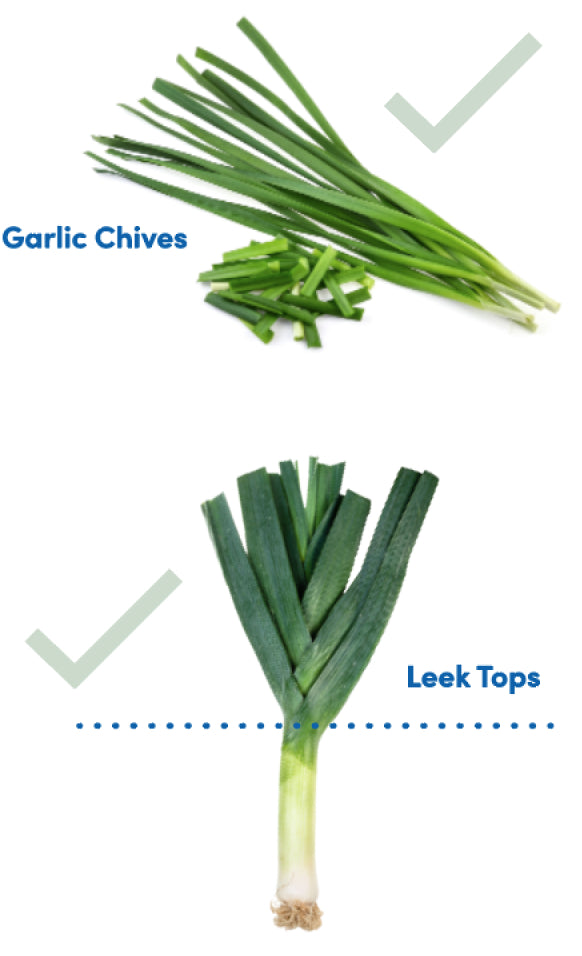
Fresh garlic chives and the green tops of leeks are safe bets and add very similar flavors to your dishes! Find these ingredients in many asian markets, farmers markets, or easily grow them in a pot at home, or in your own garden.
Available in some parts of the U.S. in June and July, garlic scapes have also been shown to be well-tolerated by FODMAP-sensitive individuals. Additionally, Gourmend offers both an Organic Garlic Scape Powder and an Organic Garlic Chive Powder — FODMAP Friendly certified options for cooking, when used in moderate amounts. For adding a little zest to vegetables, soups, or meats sprinkle in about 1/4 tsp (per serving).
#2
Use Onion Substitutes
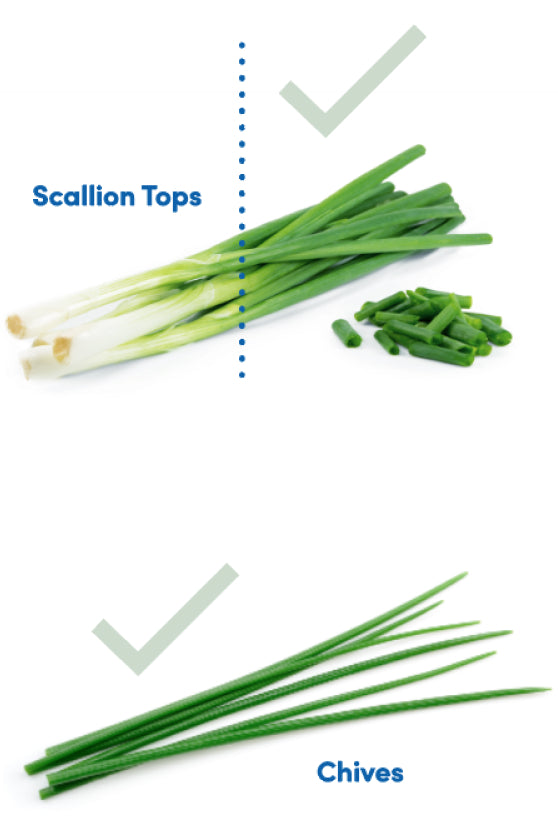
The simplest everyday swap is Gourmend’s Organic Green Onion Powder. It’s made from the green tops of scallions — the part that carries the onion flavor without the fructans — dried and milled, so you can reach for it anywhere a recipe calls for onion powder. Start with about 1/4 tsp per serving.
You can also add a burst of onion flavor to your cooking with:
- Leek tops
(no practical limit — tested low at a pound or more) - Scallion/green onion tops
- Fresh and dried chives
- Asafoetida powder
Commonly used in Indian cooking and sold at Indian markets, asafoetida powder (also known as hing) can replace the flavor of onion. Asafoetida is a potent spice with a pungent scent, and a little goes a long way — the tested low serve is 2 g (¼ teaspoon), and in practice a pinch. One caution: most commercial asafoetida is compounded, and the most common carrier is wheat flour, which adds fructans back and makes it unsafe for anyone with celiac disease. Buy one labeled gluten-free or wheat-free, and read the panel rather than assuming.
Do not just sprinkle asafoetida on top of your finished meal, as the resulting taste will be rather forward and unpleasant. To temper its bitterness and release the exotic flavor of this spice, add a pinch of asafoetida to hot oil or butter, mixing it into the spices that have already been added to the fat. After it is all mixed and dissolved, you can combine the mixture with your vegetables, meats, or rice.
At Gourmend, we’ve replaced the onions and garlic commonly found in off-the-shelf stocks with the green parts of leeks and scallions to produce Organic Chicken Bone Broth, Organic Beef Bone Broth and Organic Vegetable Broth that let you skip the onion, and still prepare and share delicious meals with your family.
#3
Use Infused Oils
Fructans are not soluble in oil, so the fructans in onions and garlic won’t leach out into the food you’re cooking... but the flavor will!
So how do you prepare stir-fries and other oil-based dishes with onions and garlic? Upgrade your meals by cooking with an onion- or garlic-infused olive oil.
A store-bought infused oil is the safer choice. Commercially prepared oils are processed and bottled to be shelf stable, which removes the botulism window entirely. We like Bona Furtuna’s Garlic Infused Olive Oil — organic Sicilian olive oil infused with garlic, with no garlic solids in the bottle.
If you infuse your own: heat oil in a frying pan and add a large slice of onion or a whole garlic clove to draw out the flavor. Then remove every piece before anything else goes in the pan. The clove itself is still high FODMAP, and solids left in the oil are also the unsafe version. Refrigerate the oil immediately and use it within 4 days — the National Center for Home Food Preservation’s limit, and Oregon State Extension’s — or freeze it. Never leave garlic-in-oil at room temperature: the bacteria that cause botulism grow well in it, and the oil gives no visible warning.6
This trick only works in oil. Fructans dissolve in water, so dropping a whole onion or garlic clove into a soup, stock, braise or any other wet dish and fishing it out later does not work — the fructans have already leached into the liquid.
#4
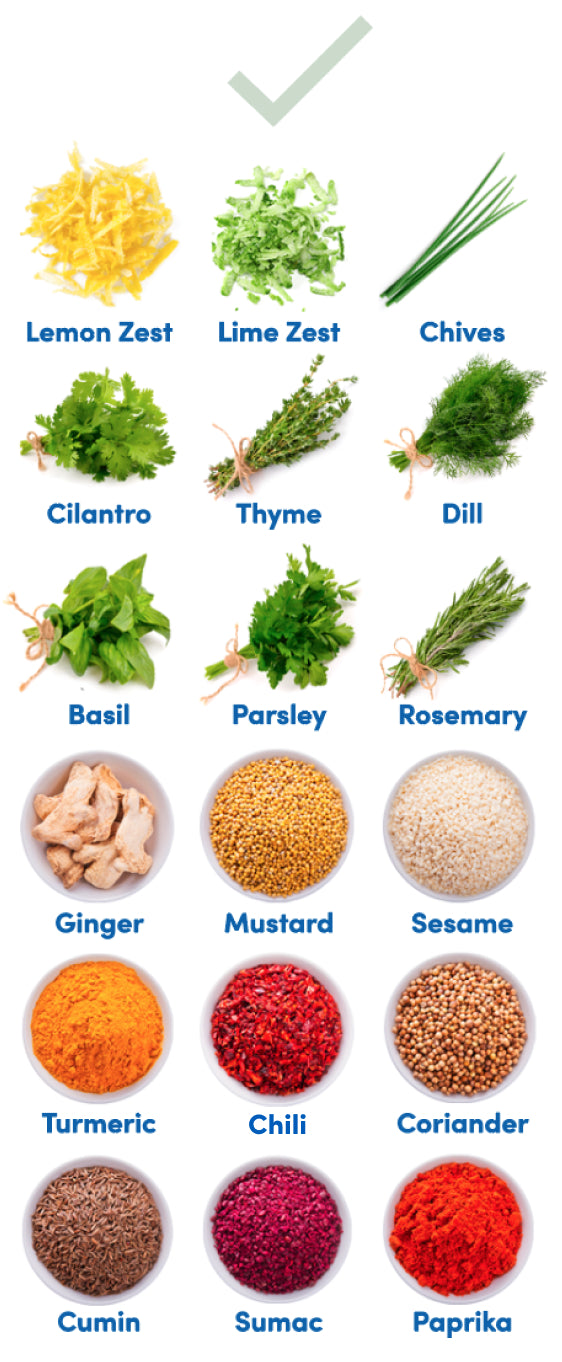
Use Other Herbs & Spices
Experiment with seasoning and cooking with herbs and spices that are garlic and onion-free. To infuse your meals with flavor, cook with low-FODMAP ingredients like:
- Lemon/lime juice and zest
- Herbs like thyme, basil, chives, parsley, lemongrass, dill, oregano, cilantro, rosemary and most others.
- Ginger, mustard seeds, sesame seeds, sumac, turmeric, chilis, coriander, cumin and many others.
Pre-mixed spice blends are usually where hidden garlic and onion turn up, so they’re worth reading carefully — or skipping in favor of one built without them. Gourmend’s Low FODMAP Taco Seasoning is a ready-made example, and a good illustration of the two swaps above working together: chile powder, cumin, coriander, and black lime, seasoned with garlic scape and green onion powder instead of onion and garlic bulbs. For the full list of what’s safe, see our 57 low FODMAP herbs, spices and seasonings.
Be aware: While most fresh and dried herbs and spices are carbohydrate-free (and therefore low-FODMAP) some IBS sufferers have noted intolerance with particularly spicy seasonings such as chili, which contains capsaicin and may aggravate IBS symptoms. Modify recipes accordingly and determine what works best for you.
Part 4 Proteins & Legumes
In this chapter, we'll go over:
- The high-FODMAP proteins and legumes you should avoid
- What to look for on labels
- How low-FODMAP meats, vegetarian proteins, legumes, and pulses can be part of a diet full of flavor and variety
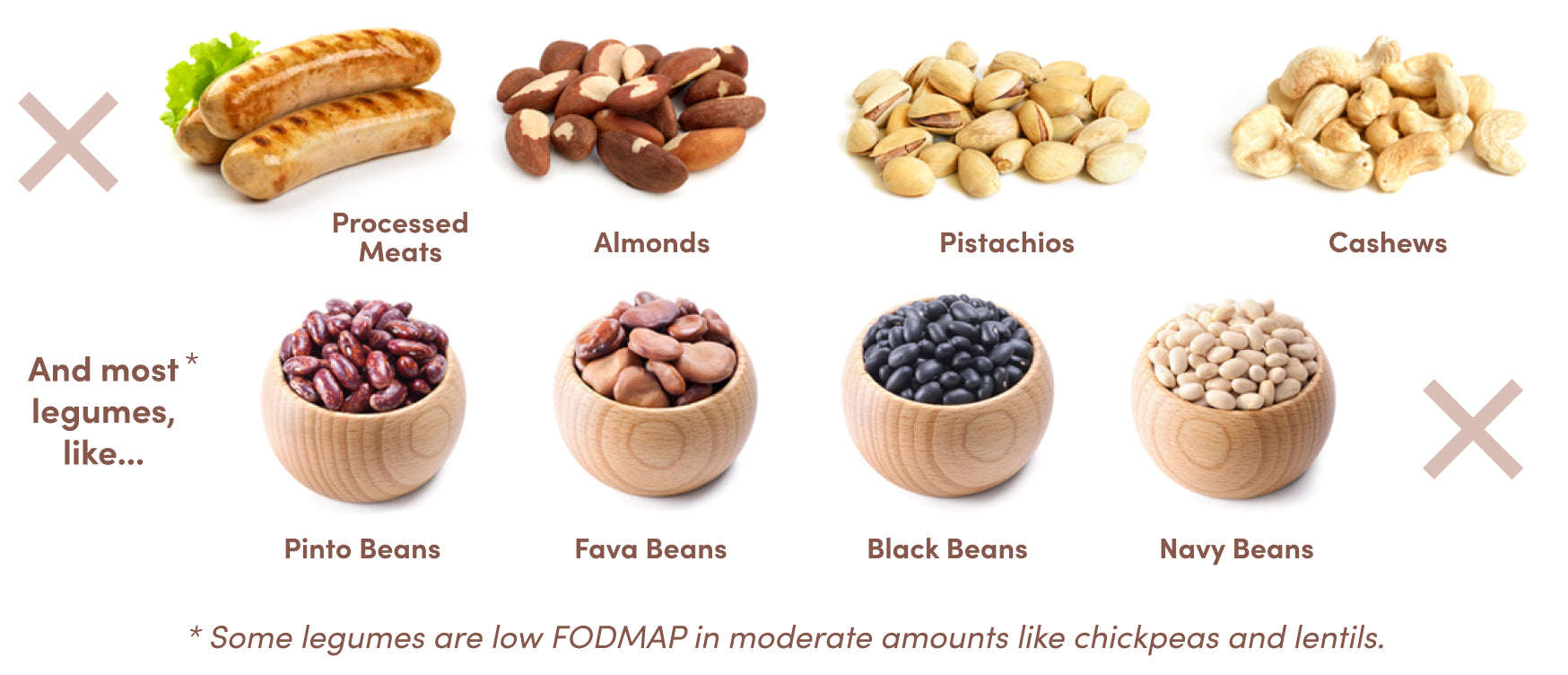
Avoid high-FODMAP proteins and legumes, including:
- Sausages, hot dogs, and other processed meats (which are often flavored with garlic, onions, wheat, or a combination of many gut-aggravating FODMAPs)
- Broad (fava) beans, butter beans, baked beans, black-eyed peas, split peas, and soybeans
- Cashews and pistachios
A note on almonds: they’re low FODMAP at 10 nuts (about 12 g) and only high at 20 or more. If the Monash app shows almonds with a red dot, that’s its default serving size talking, not the nut — check the smaller serve.
There are plenty of low-FODMAP proteins that are safe to eat, including:
Meat
- Beef
Including ground beef - Ham
Prosciutto, cold cuts, and other deli meats (as long as they haven’t been flavored with onion or garlic powder — celery-juice curing is fine) - Lamb
- Pork
Poultry
- Chicken
- Duck
- Turkey
Fish & Seafood
- All fresh fish
- Canned tuna
- Crab
- Mussels
- Oysters
- Lobster
- Prawns
- Shrimp
Meat Substitutes
- Almond butter (1 tbsp)
- Almonds (10 nuts, about 12 g), macadamia nuts, peanuts, pine nuts, pecans and walnuts
- Peanut butter
- Sesame and sunflower seeds
- Firm tofu (drained or pressed, 170 g), tempeh (170 g) and edamame (75 g). Silken tofu is high FODMAP in a standard serve — skip it.
Be sure to check the labels:
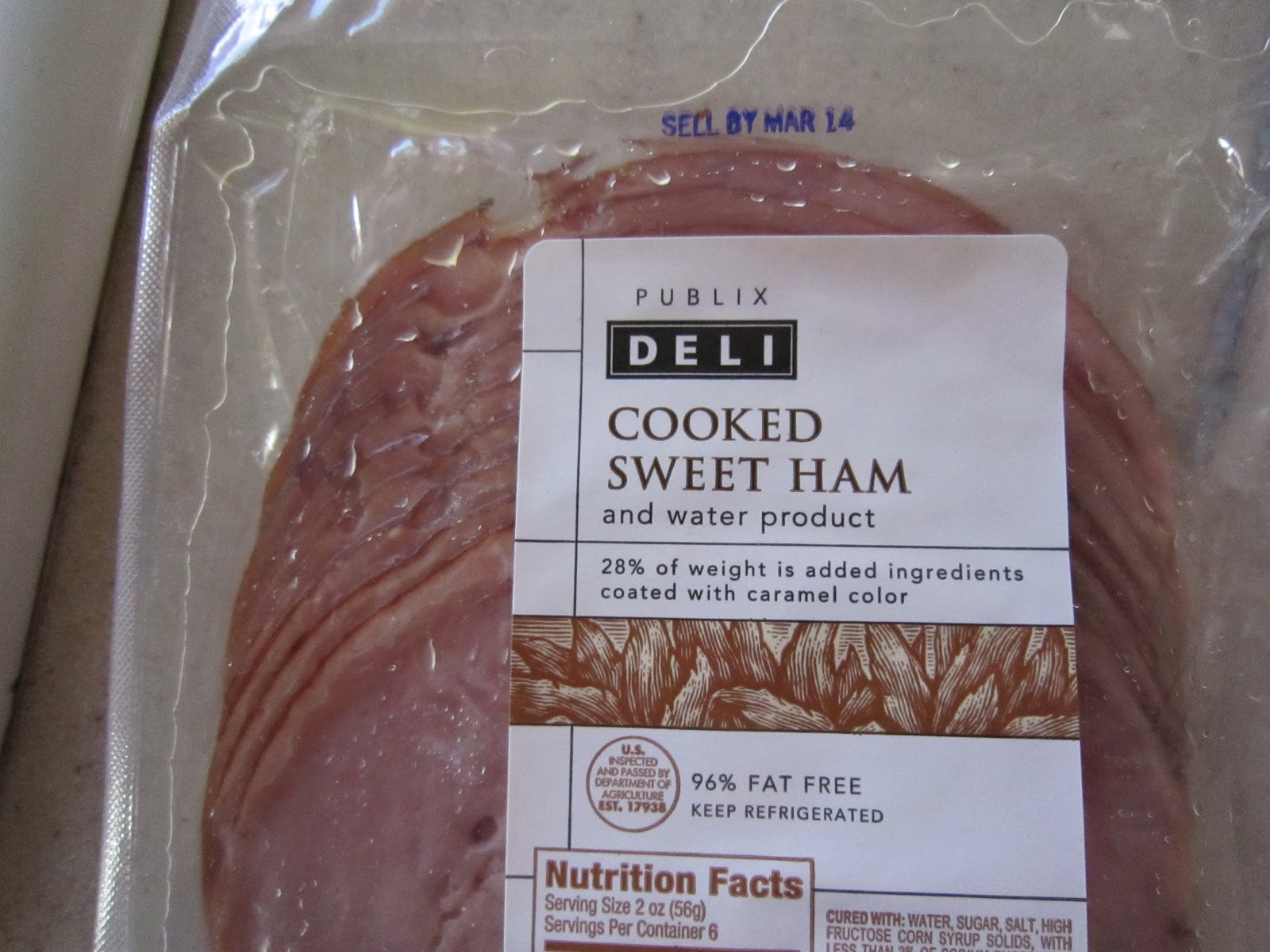
- Stick with poultry, meat, and seafood that contain only salt (if anything) and are fructose and preservative-free.
- In the case of cold cuts and deli meats, be certain that no garlic, onion, honey or molasses was added for seasoning. Celery powder used as a curing agent is fine — it’s a fraction of a gram per serving, far under celery’s 74 g threshold.
- Tuna filets and canned tuna can be included in your low-FODMAP diet. Check the label of water-packaged tuna, however, as some brands use a combination of water and a potentially high-FODMAP broth.
Legumes & Pulses
Legumes and pulses can be a problematic food because they are naturally high in galactans, an oligosaccharide. But a flavorful, robust diet doesn’t have to be void of legumes!
Canned legumes, and legumes that have been boiled and drained have been shown to have less FODMAP content than their unprocessed counterparts. This is because the galactans in legumes seep out and dissolve into the water that they are cooked or canned in.

How to enjoy legumes while restricting FODMAP proteins:
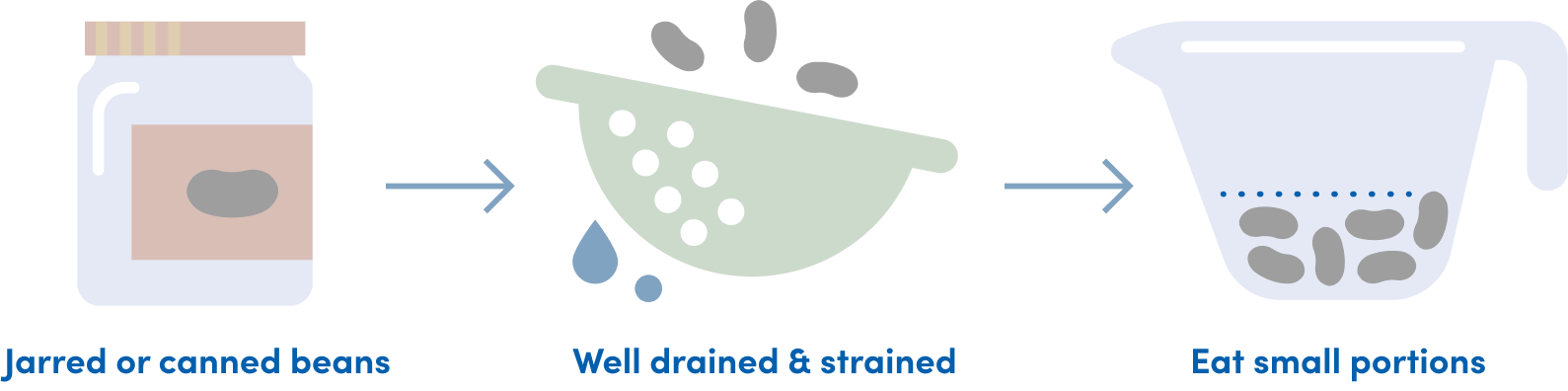
- Choose jarred or canned legumes (well–drained and rinsed), such as canned lentils, which contain half the FODMAP level of those that are freshly boiled from their dried counterparts. That’s because more of the FODMAP content has had a chance to leach out into the can’s water during processing and storage.
- After cooking fresh legumes, always strain them to avoid consuming any FODMAP-saturated water. You might even try leaving them soaking in water in the refrigerator overnight and discarding that water, too, before eating.
- Eat small portions of legumes while on a low-FODMAP diet. The safest choices are lentils and chickpeas—but you can also enjoy very small amounts of other favorites like kidney beans, canned pinto beans, black beans, adzuki beans, lima beans, and mung beans. To obtain the specific serving sizes of these beans, download the Monash University FODMAP Diet app.
- Prepare dried beans with digestibility in mind. Soak them, discard the soaking water, and skim the foam that rises as they cook. Pressure cooking or sprouting softens them further. Each step carries off more of what makes legumes hard to tolerate.
- Cook them with digestion-friendly aromatics. Adding a bay leaf, a strip of kombu seaweed, a little epazote, or a pinch of asafoetida to the pot is a long-standing kitchen practice for making beans sit more comfortably — and asafoetida does double duty as the onion substitute described in Part 3.
- Finish with carminatives — herbs and spices traditionally used to ease gas and bloating. Cumin, coriander, ginger, mint, parsley, cilantro, and dill are all low FODMAP, all pair naturally with legumes, and can be stirred in at the end or scattered fresh over the top.
- Slow down at the table. Chewing thoroughly and eating at an unhurried pace gives digestion a head start, which matters more with legumes than with almost anything else on your plate.
Be aware that although canned legumes may have a reduced-FODMAP content, they can still be a significant FODMAP source. If you are sensitive to legumes and pulses, even in small quantities, consider relying on other low-FODMAP sources for protein.
Part 5 Wheat & Grains
In this chapter, we'll explain:
- What high-FODMAP grains and wheat-based foods should be restricted
- How to include corn and rice in your diet
- How to select whole-grain, low-FODMAP alternatives to wheat
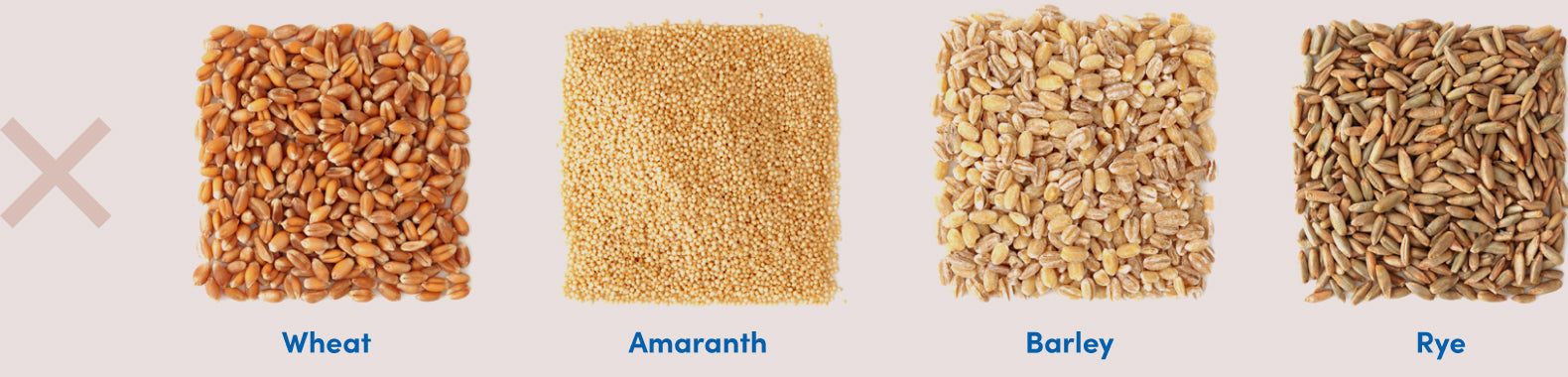
Wheat, Amaranth, Barley, and Rye
Wheat is the primary source of FODMAPs in the Western diet. This is not because wheat is a concentrated FODMAP source, but rather because we consume this carbohydrate in large quantities.
In fact, wheat contains one of the lowest amounts of FODMAPs by weight. Wheat-based flavorings, thickeners, and foods that contain wheat as a minor ingredient are generally low-FODMAP. That said, anyone on the low-FODMAP diet should restrict wheat-based bread, breakfast cereals, biscuits, pasta, and pastries and select low-FODMAP, whole-grain alternatives.
Barley and rye are high in FODMAPs and worth limiting during elimination. Amaranth depends on the form: amaranth flour is high FODMAP, while puffed amaranth is on Monash’s low-FODMAP grain list, at about ⅓ cup.
Gluten Free vs Low FODMAP
Despite the fact that gluten and FODMAPs are present in many of the same foods, FODMAPs and gluten are not interchangeable.
Those diagnosed with celiac disease have an auto immune reaction to gluten,7 which is the protein found in barley, brewer’s yeast, rye, and wheat – those that have this disease cannot have any grains or products that contain gluten. Someone with a FODMAP sensitivity, on the other hand, suffers from a reaction to fructans, the specific carbohydrate type found in barley, rye, and wheat.
It is possible that individuals with celiac disease or non-celiac gluten sensitivity (gluten sensitivity) may have trouble digesting FODMAP carbohydrates as well. Provided that gluten ingestion has been ruled out as an issue, individuals with celiac disease or gluten sensitivity whose symptoms do not subside even after cutting out gluten may want to discuss trying the 3-step, low-FODMAP diet outlined in Part 2 above with their dietitian, as some studies8 have shown this to be a help.
It’s probably not the gluten. In a blinded trial of 59 people who believed they were gluten-sensitive, each ate identical muesli bars spiked with gluten, with fructans, or with neither. The fructan bar made people feel worse; the gluten bar was no different from placebo, and only 13 of the 59 had their worst week on gluten (Skodje et al., Gastroenterology 2018). A 2025 review in The Lancet reached the same conclusion for non-celiac gluten sensitivity as a whole (Biesiekierski et al., Lancet 2025). It matters for your wallet as well as your gut: gluten-free products cost around 139% more than their standard equivalents, and if fructans are the real trigger, the sourdough and portion advice in this Part gets you there without the premium.
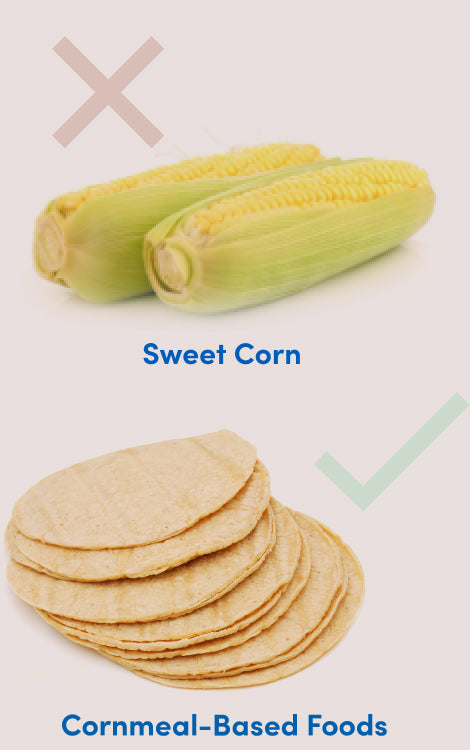
Corn
Sweet corn’s sweetness comes from its sugars — sucrose, glucose and fructose. It also carries a small amount of sorbitol, and that is what caps the serving: about ½ cup of kernels (75 g) is low FODMAP, whether cut fresh from the cob or canned. Beyond that it tips to moderate.
The types of corn that are meant to be ground into cornmeal (corn flour, masa harina, or masarepa) are lower in the FODMAP sorbitol and higher in starch.
Since starch is not a FODMAP, arepas, corn tortillas, corn pasta, grits, polenta, pupusas, tamales, and other ground-corn based foods can be consumed by individuals on a low-FODMAP diet.
Be aware: Be certain that other high-FODMAP ingredients have not been added before including any of the ground-corn foods mentioned above in your diet.
Rice
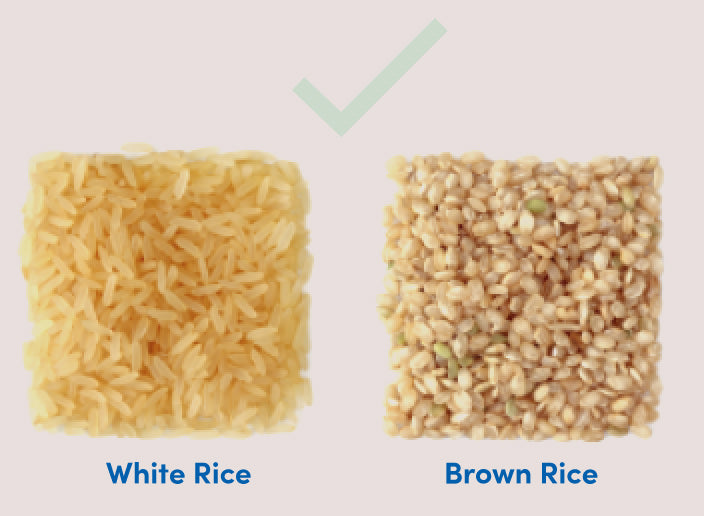
Brown and white rice are both low in FODMAPs, so experiment with recipes using these low-FODMAP ingredients.
When cooking rice, do not use broths or stocks that contain garlic or onion. Avoid preparing rice with coconut water as well. Instead, stick to rice cooked with water or a low FODMAP broth — our chicken, beef or vegetable — and a dash of Organic Garlic Scape Powder for extra flavor.
Alternative Low-FODMAP Grains
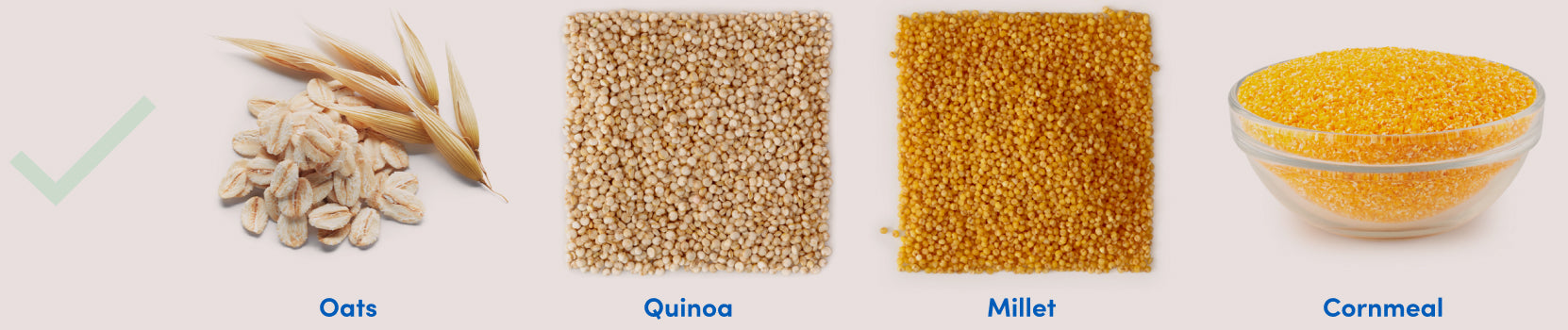
In addition to rice, select whole-grain, low-FODMAP alternatives like buckwheat, millet, oats, cornmeal (e.g. polenta), quinoa, and tapioca-based foods.
Sprouted Grains
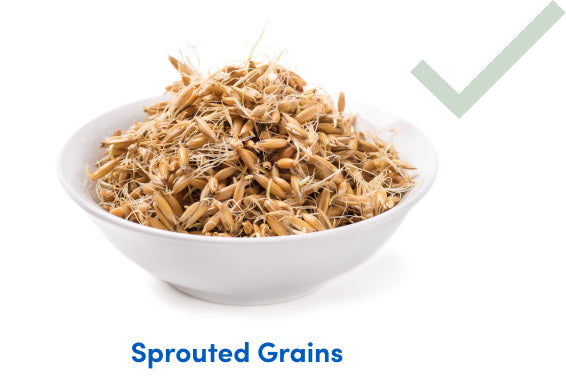
Sprouting reduces FODMAPs in some grains and legumes, but not all. In Monash’s testing9, five of six foods came down — mung beans and barley moved from high to low — while chickpeas went slightly up. Sprouted-grain breads haven’t been tested. To test sprouting’s effectiveness for yourself, eat a small amount of the sprouted grain and monitor your tolerance.
Sourdough Breads
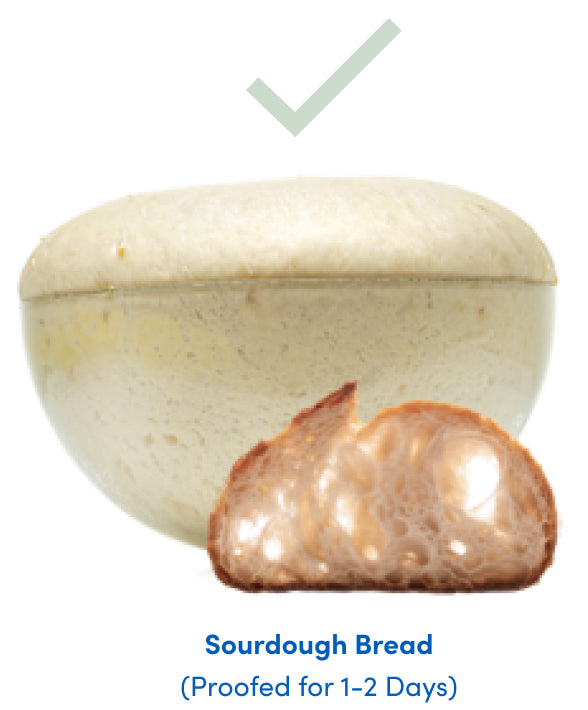
Well-made sourdough bread can be low FODMAP, since there is a fermentation step involved in the process of making it. This fermentation step has been shown to reduce the fructan content by over 70%10, because the yeasts ferment the fructans during the process of leavening bread.
The label doesn’t establish the process, though. Supermarket breads sold as “sourdough” are frequently yeast-leavened with sourdough flavoring and haven’t had the fermentation time to break the fructans down. Added baker’s yeast doesn’t disqualify a bread — insufficient fermentation time does. Tested low serves: white wheat sourdough 2 slices (109 g), wholemeal wheat sourdough 2 slices (97 g), spelt sourdough 2 slices. Rye and kamut sourdoughs have not tested low.
Traditional sourdough breads made from wheat and spelt flours are low FODMAP because of these decreased fructan levels. Dough should proof (i.e. the process of leaving it to rise) for 1-2 days, using a starter that has fermented for at least 12 hours, to achieve high-quality, FODMAP-safe bread.
Although sourdough bread can be found on supermarket shelves, making your own or buying bread from a trusted artisan or local baker you can talk with is a great way to ensure that this slow fermentation process has occurred.
Part 6 Fruits & Vegetables
In this chapter, we'll explain:
- The difference between fructose and fructans
- What makes certain fruits and vegetables low in FODMAPs
- When and how to include high-FODMAP fruits and veggies into your diet
Fruit
Although they are both FODMAPS, fructose is not the same as fructans.
Fructose is a fruit sugar naturally found in honey, vine and tree fruits, and most root vegetables. Fructans are a type of carbohydrate made by a chain of fructose molecules strung together.
All fruit naturally contains fructose, and some fruit contains glucose.
Glucose is an important non-FODMAP sugar, as it helps your body absorb fructose.
Although glucose is not a FODMAP, fruit that contains more fructose than glucose is considered high-FODMAP.
In addition to fruit that contains high amounts of excess fructose, fruit that is high in fructans and / or contains high amounts of sorbitol should be avoided, as these have also been designated as high-FODMAP.
Limit these high-FODMAP fruits:
- Apricots
- Apples
- Avocados
(low up to 60 g, about 3 tbsp) - Bananas
(ripe: low up to ⅓ medium, 35 g — a firm, unripe one is fine whole) - Blackberries
- Cherries
- Dates
- Figs
- Grapefruit
- Mango
- Nectarines
- Peaches
- Pears
- Plums
- Raisin
- Watermelon
Enjoy these low-FODMAP fruits*:
- Bananas
(unripe) - Blueberries
- Cantaloupe
- Clementines
- Coconut
- Dragonfruit
- Honeydew Melon
- Kiwi fruit
- Lemon
- Lime
- Oranges
- Papaya
- Passionfruit
- Pineapple
- Raspberries
- Rhubarb
- Starfruit
- Strawberries
*To obtain the specific serving sizes of these foods, download the Monash University FODMAP Diet app.
Vegetables
Vegetables contain the most diverse range of FODMAPs and several vegetables actually contain more than one FODMAP type. Swap out high-FODMAP vegetables for low-FODMAP choices.
Skip these high-FODMAP vegetables:
- Artichokes
- Asparagus
- Beans
(dried and canned legumes — green beans are fine) - Brussels sprouts
- Garlic
- Mushrooms
(except oyster which are low!) - Onions
- Peas
Portion-limited, not off-limits: cauliflower is low FODMAP at about 75 g (¾ cup) since Monash retested it in May 2025; celery at 74 g (about half a medium stalk); butternut squash at about 45 g cooked (⅓ cup); corn at about ½ cup of kernels (75 g), fresh or canned. Go past those amounts and they tip into moderate or high.
Enjoy these low-FODMAP vegetables:
- Alfalfa
- Arugula
- Bamboo shoots
- Bean sprout
- Bok Choy
- Broccoli
(as few stems as possible) - Cabbage
- Carrots
- Cucumbers
- Chili peppers
- Bell peppers
(green up to 75 g; red up to 43 g) - Eggplant
- Endive
- Fennel
- Ginger
- Green beans
- Leek tops
(green parts) - Lettuce
- Kale
- Okra
- Olives
- Potatoes
- Radishes
- Scallion tops
(green parts) - Spinach
- Summer Squash
- Tomatoes
(regular up to 65 g, cherry up to 45 g) - Turnips
*To obtain the specific serving sizes of these foods, download the Monash University FODMAP Diet app.
Part 7 Dairy
In this chapter, we'll explain:
- The high-FODMAP dairy products that should be removed from your diet
- The difference between traditional yogurt and Greek yogurt
- Low-FODMAP dairy items and dairy alternatives that are safe to eat
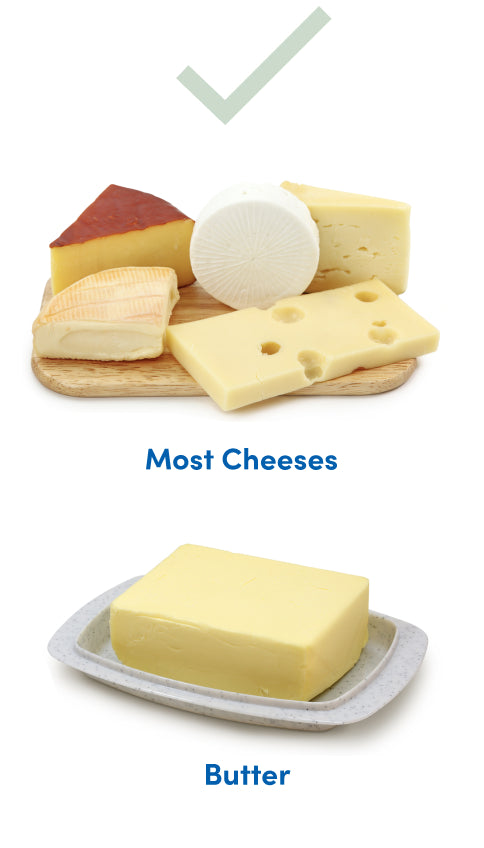
Although the FODMAP lactose is found primarily in dairy products, an extensive number of dairy products are naturally low in lactose. That’s because many dairy products, like most hard and matured cheeses, lose their lactose during the cheesemaking process.
The following high-FODMAP dairy products should be replaced with lactose free versions:

- Milk & cream
- Yogurt & kefir*
- Cottage & ricotta cheese
- Ice cream & gelato
*Traditional vs. Greek Yogurt
Yogurt is produced when the bacteria Lactobacillus bulgaricus and Streptococcus thermophilus are added to milk, causing the milk to ferment.
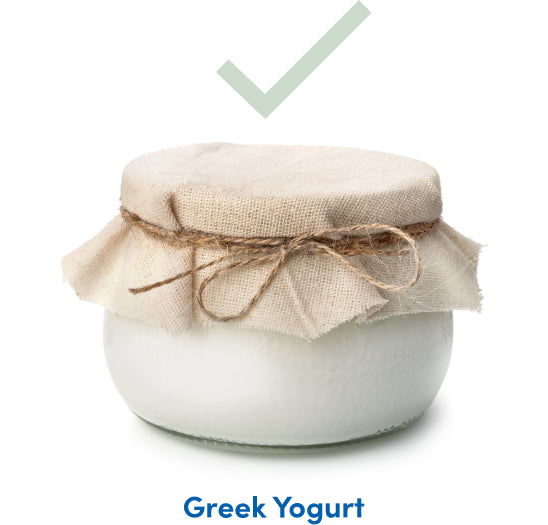
Greek yogurt is the result of straining yogurt after this fermentation process, which removes the watery whey that contains much of the lactose and yields a yogurt that is higher in fat and lower in lactose11. But “lower” is relative: Monash’s testing puts plain Greek yogurt at low FODMAP only up to about 23 g (2 tablespoons), moderate at 93 g and high at 170 g — so a 6-ounce bowl is a high-FODMAP serving. FODMAP Friendly’s testing is far more permissive, so the two labs genuinely disagree here — one more reason lactose-free yogurt is the easy everyday choice at a normal portion.
In addition there are plenty of other low-FODMAP dairy items and dairy alternatives that you can eat, including:
Cheeses
- Safe at about 1 slice or 40 grams (not flavored with onion or garlic), including: Brie, Cheddar, Colby, Goat, Havarti, Mozzarella, Monterey Jack, Parmesan & Swiss
Butter
- Butter is made of milk, but its high-fat composition makes it naturally low in lactose and FODMAP safe!
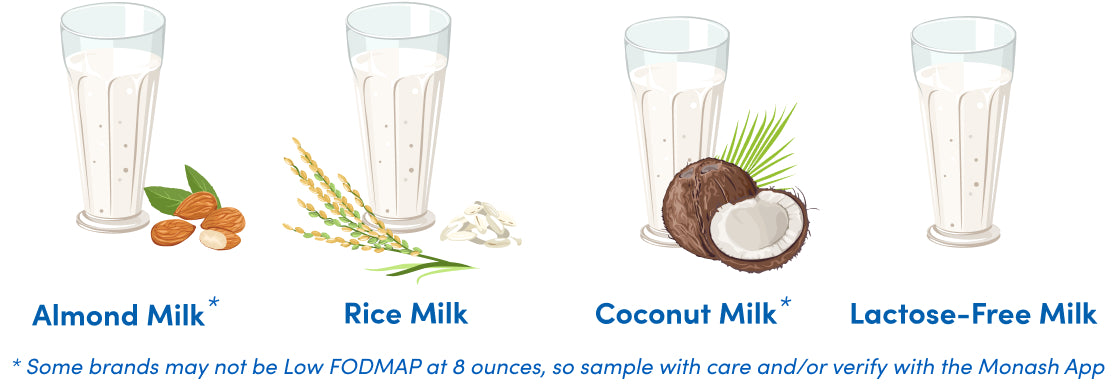
Milk Alternatives
- Lactose-free milk
- Almond milk (250 ml)
- Macadamia milk (250 ml)
- Rice milk (200 ml)
- Hemp milk (125 ml)
- Coconut milk, carton (125 ml, about ½ cup)
- Oat milk (100–125 ml — see below)
- Soy milk made from soy protein (250 ml)
Oat milk is the one people get wrong. It’s low FODMAP at only about 100–125 ml — less than the milk in a standard latte — so it needs its own measure rather than a free pour.
Soy milk depends on how it’s made. Made from soy protein or isolate it’s low FODMAP at 250 ml; made from whole soybeans it’s high (GOS). The front of the pack won’t tell you — read the first ingredient. US products are more often protein-based.
Whatever the base, check “barista,” “enriched” and “extra creamy” versions for added inulin or chicory root fiber, agave or high fructose corn syrup.
A Word on Lactose Intolerance
If you are an IBS sufferer on the low-FODMAP diet, consult with your doctor or dietitian to determine if you are also lactose intolerant. It’s possible that you may only need to restrict lactose if you are lactose intolerant.
According to research, regularly consuming small portions of dairy throughout the day may minimize your intolerance of the FODMAP lactose.12 Rather than eating dairy alone, using dairy as an ingredient in a dish you prepare may also increase your tolerance of lactose
If you are restricting lactose, there are several products that contain lactase, an enzyme that can help you better digest lactose. Available from most pharmacies, lactase tablets or drops are an enzyme supplement that may help some people who are lactose intolerant better digest lactose.
Part 8 Beverages & Sweeteners
In this chapter, we'll look at:
- High-FODMAP beverages and sweeteners to avoid
- What low-FODMAP sweeteners and beverages to select
- Why beverages with low-FODMAP ingredients can still be high FODMAP
Beverages
Beverages are a source of significant FODMAPs, even if the beverage was not made from blatantly high-FODMAP ingredients.
Some beverages are naturally high in FODMAPs, while additives and sweeteners may spike the FODMAP levels of otherwise low-FODMAP beverages.
Skip these high-FODMAP beverages:
- Sodas containing high fructose corn syrup (HFCS)
- Juices containing HFCS, agave or honey
- Strong herbal tea
- Strong black tea
- Strong chai tea
- Rum
(high in excess fructose) - Cider
(never formally tested; likely keeps the fruit’s polyols — an inference, not lab data)
- Strong dandelion tea
- Fennel tea
- Chamomile tea
- Oolong tea
- Coconut water
- Whey protein and milk-based health shakes
- Apple, pear and mango juice
(orange juice is different — low at about 125 ml, see below)
Enjoy these low-FODMAP beverages:
- White and green tea
- Peppermint tea
- Weak chai tea
- Weakly brewed black and herbal teas
(steeping time is the mechanism: one bag, 1–2 minutes, then remove it. Chamomile, fennel and oolong are high regardless of strength, so “weak” doesn’t rescue them) - Pure hot chocolate
(made from cacao powder and sweetened with regular sugar)
- Black coffee
(brewed 180 ml; espresso 30 ml single, 60 ml double) - Plain tomato juice, up to 200 ml
(skip mixed vegetable juices like V8 — the celery and beet concentrates in them have no tested low serve) - Cranberry juice (pure, without high fructose, apple juice and pear juice)
- Flavored waters or lemonade
(as long as flavored with basic table sugar / sucrose) - Dry wines, beer & spirits
(see notes below)
A note on dairy:
Adding cow’s milk, dairy creamer, or soy milk to your coffee can alter its FODMAP content. Although coffee is low in FODMAPs, a serving size of coffee containing milk or creamer may contain high amounts of the Oligos-GOS or high amounts of lactose. If you malabsorb lactose, refrain from adding dairy to your coffee.
A note on caffeine:
Drinking caffeinated beverages may cause digestive distress in some people because caffeine is a bowel stimulant. Despite being low-FODMAP, coffee and tea containing caffeine have been linked to IBS symptoms. It’s important that you work with a registered dietitian to evaluate your personal experience with caffeine and modify your diet accordingly. Your dietitian may recommend that you transition to decaffeinated beverages.

What about juice from low-FODMAP fruit?
Although juices may be consumed, they should not be consumed in large quantities, even if associated with low-FODMAP fruits. Aim for quantities of less than half a cup.
That's because beverages made with low-FODMAP ingredients can still be high FODMAP.
Why? It's all about quantity! Juices like orange juice are generally made from oranges, which are low FODMAP, but orange juice is still considered high FODMAP once you have too much.
While oranges are low FODMAP, they do contain fructose, as well as glucose and sucrose. Glucose is an important non-FODMAP sugar, as it helps your body absorb fructose.
Although glucose is not a FODMAP, food and beverages that have more fructose than glucose are considered high FODMAP. Because of the amount of oranges used to make orange juice, an 8-ounce glass of juice has substantially more fructose than one orange, enough to make that glass high FODMAP.
A note on FODMAP stacking
Green serves add up. Several low-FODMAP portions eaten in one sitting — of any FODMAP type — can accumulate past your threshold and trigger symptoms, which Monash calls stacking (Monash). The guidance is to leave two to three hours between meals and snacks. Juice is the classic stacking trap, because it goes alongside a meal rather than as the meal.
One caveat, in Monash’s own spirit: if your symptoms are well controlled and you haven’t been thinking about stacking, don’t start worrying now. The app’s cut-offs are deliberately conservative.

What about alcohol?

Generally, alcohol is an irritant for IBS-prone individuals. Avoid digestive distress by consuming alcohol with low FODMAP food, rather than on an empty stomach. A green rating means a drink won’t contribute FODMAPs — not that it won’t cause symptoms. Roughly one in three people with IBS report alcohol itself as a trigger.
- Although it is typically made from wheat, beer is actually on the list of safe beverages for those following a low-FODMAP diet. The recommended serving size is 12 ounces or less.
- When it comes to wine, be careful which type you are drinking… and how much! Limit marsalas, ports, and most dessert wines, which are high in the FODMAP fructose. However, most red, white, and sparkling wines are a good choice. 1 glass of those drier wines, for example, are typically low FODMAP.
- Additionally, one drink containing gin, vodka, or whiskey is FODMAP safe as well. Rum is the exception — it’s high in excess fructose.
What about kombucha tea?
Monash University FODMAP researchers have tested the FODMAP content of kombucha13 and found some types to be high FODMAP. High-FODMAP kombuchas tend to be those that are flavored, causing adverse gastrointestinal reactions to the specific ingredients that are added.
In addition to reactions to flavoring, another factor to consider is that some individuals may benefit from kombucha’s good bacteria. Others may already have too much of that specific bacteria in their gut, so kombucha could cause a bacteria overgrowth.
When following the low FODMAP diet, limit kombucha to 180 ml to prevent IBS symptoms. Note that Monash tested commercial products, not home brew.

What about apple cider vinegar?

It’s true that apples are high in FODMAPs, but when it comes to apple cider vinegar, the double fermentation process decreases the high levels of fructose and sorbitol found in apples, making levels safe enough to be considered low FODMAP.
According to Monash University’s low-FODMAP app, 2 tablespoons or less of apple cider vinegar is a safe serving for anyone adhering to a low-FODMAP diet, so it’s fine in dressings and marinades. The popular claims that it “aids digestion” or “reduces bloating” aren’t backed by trials in people with IBS — that research doesn’t exist. Undiluted, it can also irritate your esophagus and erode tooth enamel. Use it as a condiment, not a remedy.
Sweeteners
Sweeteners can be another hidden source of FODMAPs, and adding sweeteners to an otherwise low-FODMAP food can raise its overall FODMAP content. Below is a list of high-FODMAP sweeteners to avoid, both alone, and when listed in any product’s ingredients.
Skip these high-FODMAP sweeteners:
- Agave
- Honey
(low only at about ½ teaspoon) - High fructose corn syrup (HFCS)
- Molasses
(low only at about 1 teaspoon) - Inulin
- Erythritol
(technically low FODMAP, but it worsens fructose malabsorption and muddies a fructose challenge — skip it during elimination) - Isomalt
- Maltitol
- Mannitol
- Sorbitol
- Xylitol
Select low-FODMAP sweeteners:
When selecting low-FODMAP sweeteners, stick with standard table sugar (listed as sugar, sucrose or glucose on labels) and maple syrup. One caveat on maple syrup: Monash’s latest testing found fructans and lowered its low-FODMAP serve to 1 tablespoon (20 ml), with 2 tablespoons now moderate. A second lab, FODMAP Friendly, still lists 50 ml with none detected — real batch-to-batch variation may explain both. If you’ve tolerated 2 tablespoons you’re probably fine; if maple syrup is a suspected trigger, 1 tablespoon is the conservative number.
Many artificial sweeteners like acesulfame K, aspartame, saccharine, and stevia are low FODMAP, but you may wish to avoid these for other health reasons.

A warning about sweeteners in beverages:
Carbonated drinks often contain high-FODMAP sweeteners like high fructose corn syrup or agave. Drinks sweetened with real sugar (cane sugar, sucrose) should be okay for most people, in moderation.
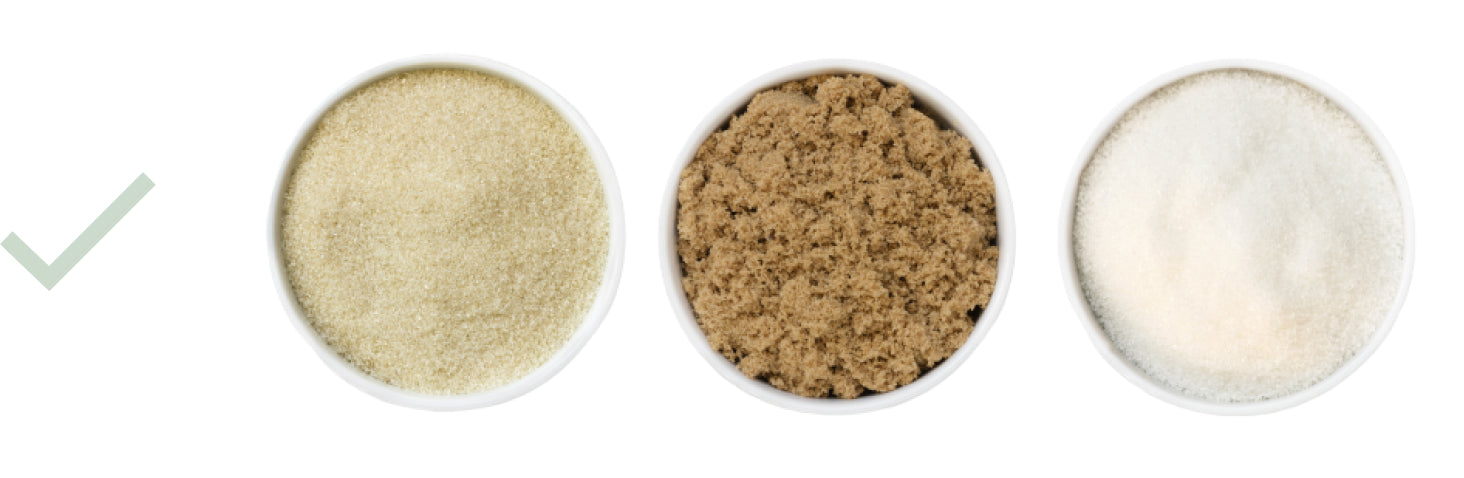
Are simple white and brown sugars a safe choice?
Sugar contains fructose and glucose in equal amounts. According to Monash University, it is safe to use as a sweetener for baking, or mixed in a drink, since sugar does not meet the definition of a FODMAP. Dark chocolate, white, brown, and raw sugar are all safe choices.
Check the Ingredients
In the case of sweeteners and beverages, some are very obviously high-FODMAP (here’s looking at you high fructose corn syrup!), while the FODMAP content of others is not so apparent. Many beverages, sweeteners, condiments, and even fruit juices can be a hidden source of FODMAPs.
With that in mind, it’s wise to always check the ingredients list on packaged foods and bottled beverages.
- Keep an eye out for apples, apple juice, or mango juice that may be used in beverages, spiking FODMAP levels.
- Check the ingredients listed on beverages and packaged foods to ensure that you avoid high-FODMAP sweeteners.
- Check the ingredient lists of mints, gum, and any food product that is labeled as “sugar free” for high-FODMAP sweeteners like sorbitol, maltito, and xylitol.
Part 9 Cooking Nutritious, Flavorful Meals
In this chapter, you’ll learn how to reclaim the full flavor of home cooking with:
- Low-FODMAP ingredients you can stock your kitchen with
- Tips for cooking low-FODMAP meals that are nutritious
- Our favorite low-FODMAP recipes for savory, healthy eating
Stock your kitchen with low-FODMAP ingredients
Two shortcuts: our printable low FODMAP ingredient shopping list and swap guide cover most of what follows — and if you’re restocking from scratch, a Gourmend bundle puts the broth, seasonings and salts in one box.
The low-FODMAP diet is one that limits certain food ingredients and is personalized to your sensitivities. The diet does not completely eliminate all foods that contain FODMAPs, however, so you don't have to settle for cooking a handful of bland dishes.
Here are the steps to stocking your kitchen with low-FODMAP food:
- Remove all ingredients that you know can aggravate your stomach from pantries and the fridge.
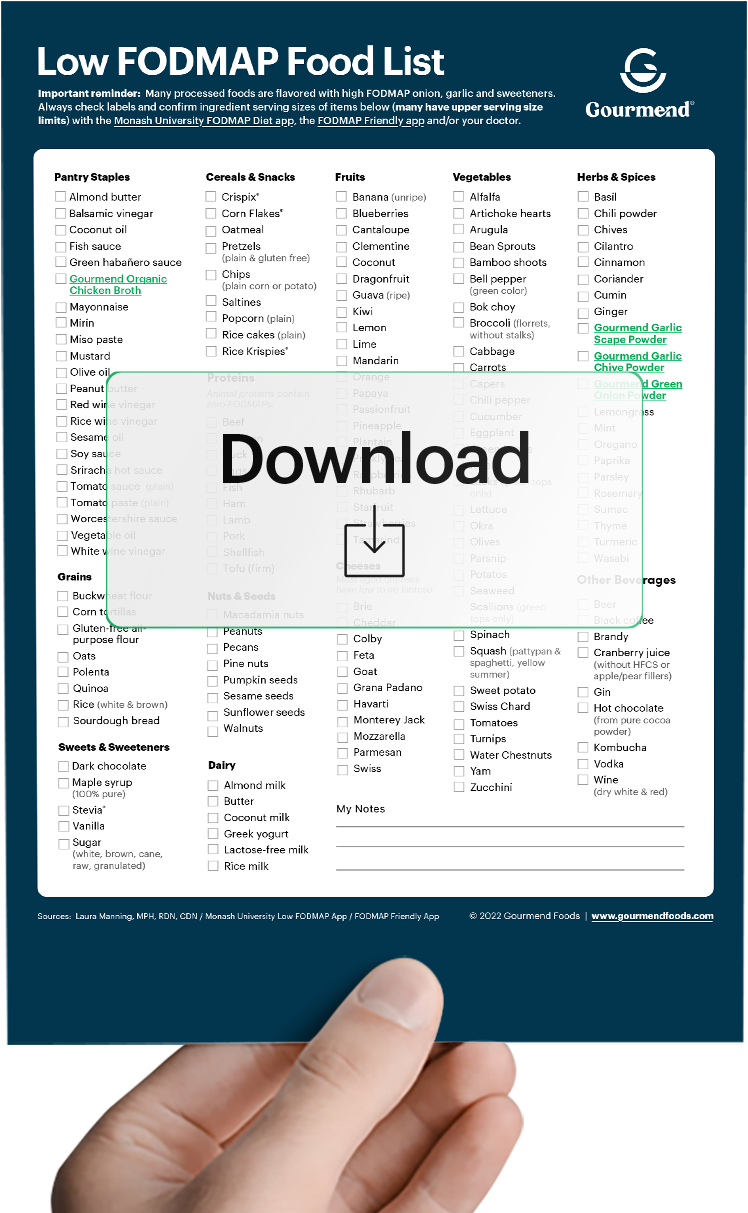
- Download and print out this convenient FODMAP-Friendly Shopping List to refer to when cooking and shopping during the week.
- Use the “Notes” section on the card to list FODMAPs that you and your dietitian have determined safe, even in small quantities.
- Finally, add any other desired ingredients to the FODMAP-Friendly side of the card, and get shopping!
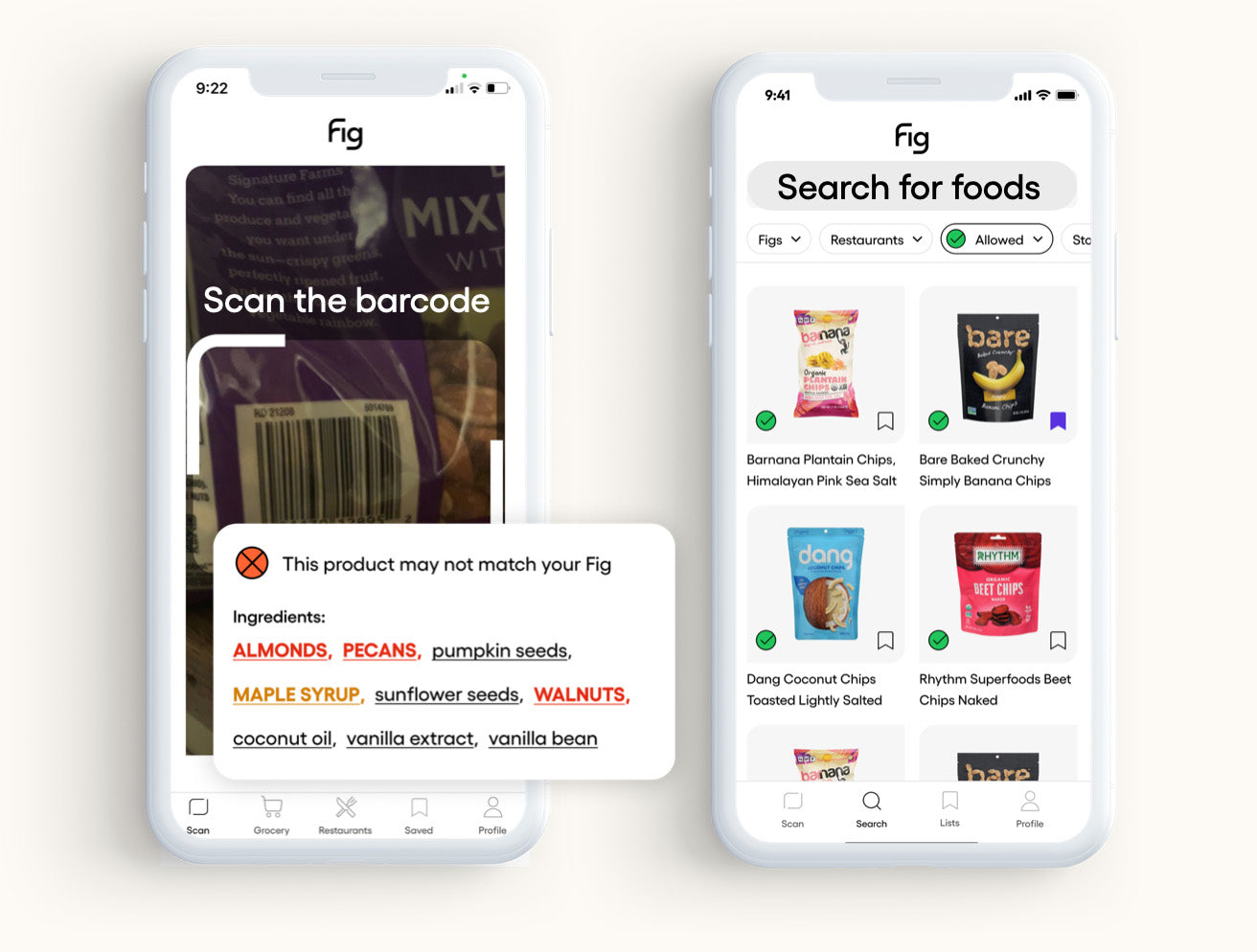
Another helpful shopping companion is Fig: Food Scanner & Guide. It’s an app that helps you find new food that matches all of your dietary needs.
Whether you’re Low FODMAP, have food allergies, or simply want to cut out certain ingredients, Fig has you covered. No more restrictions. Only options. We recommend Fig as a great resource alongside the Monash FODMAP Diet app.
From comfort foods to gourmet meals, you can cook a variety of flavorful meals if you stock your pantry and fridge with the staples listed below!
Herbs
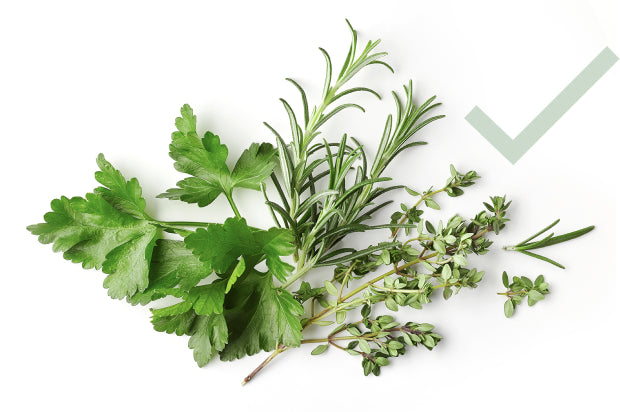
For a nourishing way to add flavor to any low-FODMAP dish, choose dried or fresh herbs like basil, coriander, parsley, rosemary, tarragon, and thyme. To have fresh herbs on hand, you can even grow your own.
Spices
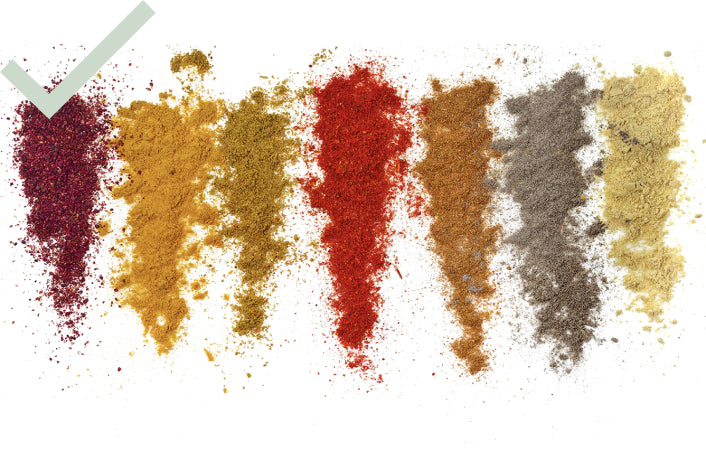
To add some kick to your meals, select cumin, coriander, ginger, turmeric, or other classic spices that have been tested and approved as low FODMAP. Don’t forget about cooking with small amounts of Asafoetida powder or our own Organic Garlic Scape Powder either!
Stock your kitchen cupboards with jars of spices like cinnamon, chili powder, smoked paprika, and fennel seeds. If you need to spice up a bland dish, try cooking with finely chopped lemongrass, or even fresh fennel leaves (without the bulb).
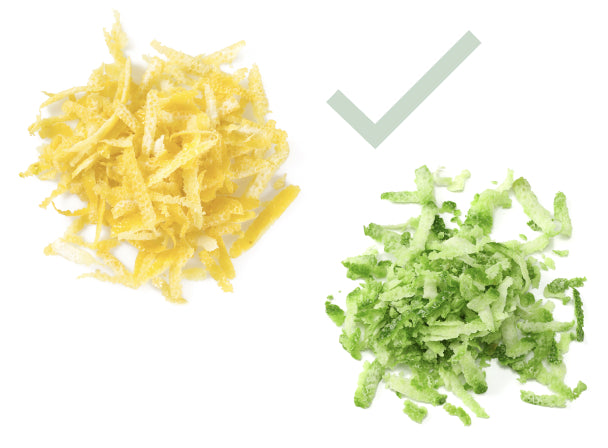
Citrus
Citrus won’t taste like garlic, but it does the same job in a dish: it adds the aromatic bite that garlic would have.
Use grated lemon zest like you would garlic in hummus, chicken marinades, and spice mixes.
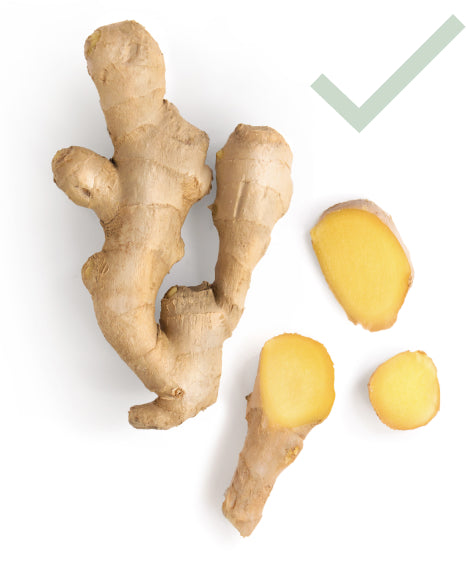
Ginger
Add fresh ginger to your grocery list and achieve a spicy aroma by creating curries and stir-fries. Store a few cups of thinly sliced ginger in your freezer for easy meals on busy weeknights.
Sliced ginger makes a good base for risottos, stir-fries, stews, soups, and other popular recipes as well.
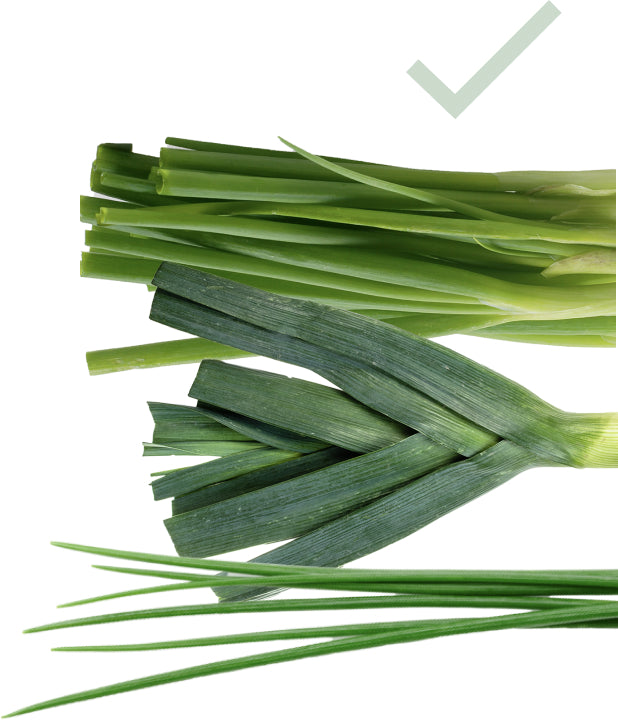
Alliums’ Green Parts
Alliums are a bulbous plant and include cultivated chives, leek, garlic, onion, scallion, and shallot. And not all alliums are taboo!
For the earthy sweetness of onion without the FODMAPs, substitute onions with the green parts of chives or scallions. You can also swap out onions for green leek tops. For maximal flavor and texture, sauté thin slices over low heat in olive oil.
If your meal is lacking depth after cutting out onions, swiss chard stems also make a tasty substitute when sautéed.
Condiments
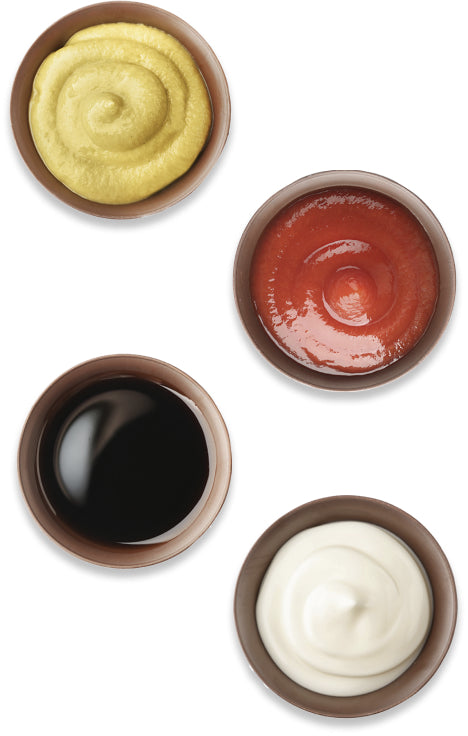
Go ahead and cook with sauces and condiments, as long as they are free of onion, garlic or high-FODMAP sweeteners as discussed in the last chapter. The following are good low-FODMAP staples to keep in your kitchen and fridge:
- Fish sauce
- Soy sauce
- Ketchup
(very small amounts) - Mustard
- Mayonnaise
- Worcestershire sauce (2 tbsp, 42 g)
- Wasabi
- Hot sauces whose label reads chile, vinegar, salt
- Sriracha (1 tbsp)
- Fish sauce (1 tbsp) and soy sauce (2 tbsp)
- Plain tomato paste
- Plain tomato sauce
Worcestershire and sriracha both list onion or garlic on the label and are still low FODMAP at those serves — the allium fraction is small and the fructans are diluted. Read every other label, though: onion and garlic hide under “spices” and “natural flavors,” most conventional ketchups contain onion or garlic powder, many mustards add garlic powder, and mainstream mayonnaise often contains onion oleoresin.
*To obtain the specific serving sizes, download the Monash University FODMAP Diet app.
A note on ketchup
Ketchup is a condiment that can be high in FODMAPs based on its fructan content. Many ketchup brands also contain high fructose corn syrup (HFCS) as well, which may cause confusion over whether ketchup should be part of a low-FODMAP diet.
Whether it’s made with high fructose corn syrup or with sucrose, up to 1 sachet (13 g, about 2 teaspoons) is low FODMAP; two sachets (26 g) is high. Small portions are key when enjoying ketchup!
A note on mustard
Mustard is a tasty condiment that you can continue to enjoy when preparing low FODMAP meals. A serving size of 1 tablespoon is low in FODMAPs and should be well-tolerated. Carefully read the ingredients on the mustard label, however, as some manufacturers may add garlic or onion as a spice or natural flavor. If onion or garlic have been added, avoid that variety and opt for a version of the tangy condiment that is made with only dry mustard powder or ground mustard and water or vinegar.
Dressings
For salads, try making your own dressing using coconut oil, olive oil, sesame oil with vinegar (apple cider, balsamic, or red wine), lemon, or a dash of dijon mustard plus some salt, pepper and a sprinkle of chives or other herbs. A finishing pinch of our Organic Garlic Chive Salt or Organic Green Onion Salt does the seasoning and the allium note in one go.
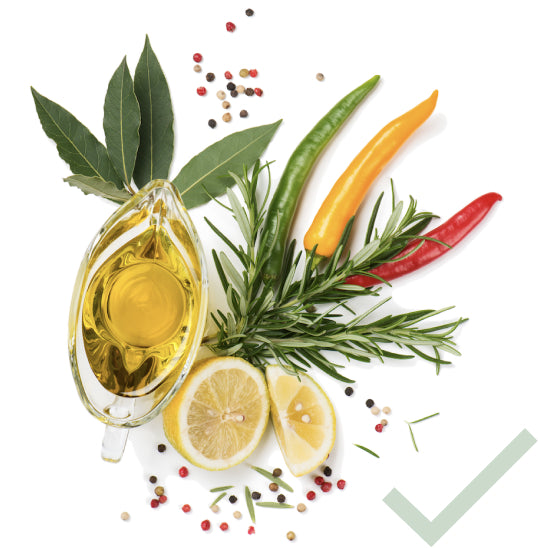
As always, check the labels to catch any hidden, high-FODMAP ingredients.
3 tips for cooking low-FODMAP, nutritious meals:
After you’ve worked with your dietitian to determine which FODMAPs are personal triggers, you may have to make modifications to the recipes you love to cook and share with your family.
With homemade stocks, low FODMAP infused oils, and a little creativity, you can put flavorful meals back on the dinner menu!
#1
Infuse Your Own Oil
The fructans in garlic and onion are often a source of IBS symptoms. Fortunately for low-FODMAP foodies, fructans are not oil-soluble, which means that by infusing oil with garlic you get all of the aromatic flavor and none of the FODMAPs. It only works in oil, though: fructans dissolve in water, so a clove dropped into a soup or stew and fished out later has already left its FODMAPs behind.
The safest infused oil is one you buy. Commercially prepared oils are bottled to be shelf stable, which removes the botulism risk entirely; Bona Furtuna’s Garlic Infused Olive Oil is a good one, with no garlic solids in the bottle. If you make your own, remove every piece of garlic once the oil has taken on its flavor, refrigerate it immediately, and use it within 4 days or freeze it. Never leave garlic-in-oil at room temperature.14
Garlic-flavored oil and garlic-infused oil are not the same!
Garlic-infused oils are made by letting garlic cloves, and garlic cloves alone, marinate in heated oil. The garlic cloves are completely removed once the desired flavor is achieved. Garlic-flavored oils have dried, fresh, or roasted pieces of garlic floating in the bottle. These pieces are the source of the flavor… And they are the reason garlic-flavored oil can be high FODMAP. If an oil contains garlic pieces, garlic salt, or garlic powder, then it has the potential to trigger gastrointestinal issues.
Always check the ingredients before cooking with any product that is labeled as garlic oil, garlic essential oil, garlic essence or garlic-flavored.
#2
Use Green Chives, Leek Tops & Scallion Tops
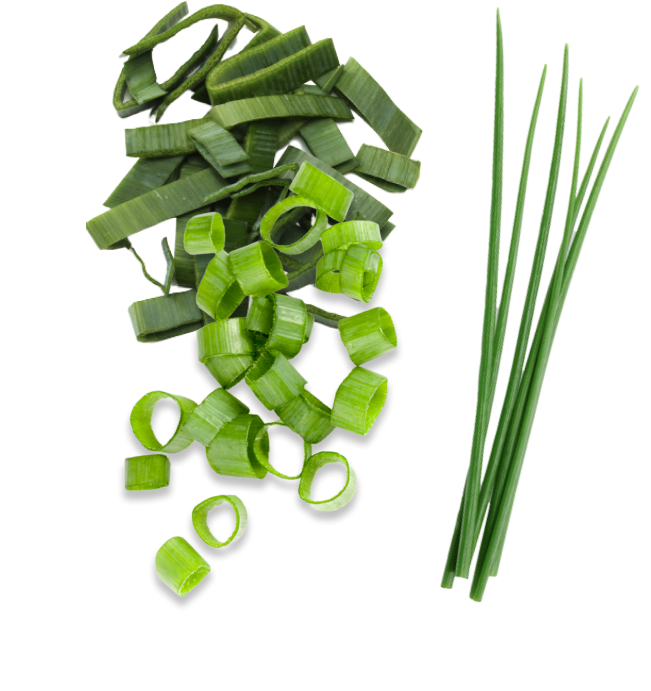
If your favorite recipes call for onion or garlic powder, Gourmend’s FODMAP Friendly certified Organic Garlic Scape Powder could be the alternative your stomach has been waiting for. Furthermore, to reclaim the robust taste of cooking with garlic or onions, slice raw scallion tops and/or chives and add a handful or two to pasta dishes, stews, salsas, and any recipe that gets its richness from alliums. Leek and scallion greens are about as forgiving as low-FODMAP food gets — tested low at serves of a pound or more — so there is no need to measure them.
#3
Grow Your Own Flavor
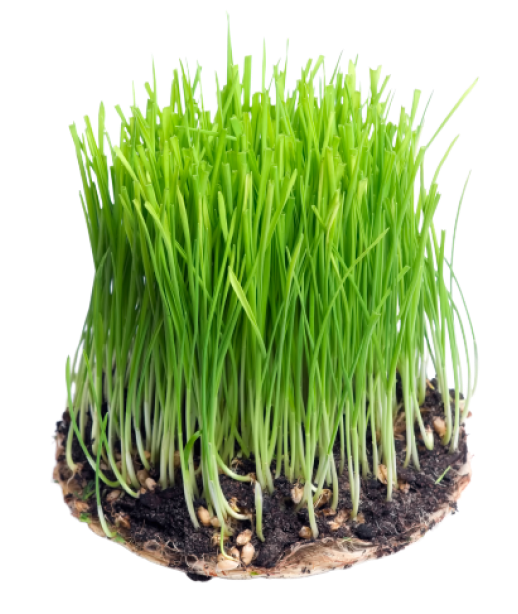
To have onion and garlic flavoring at your fingertips, grow your own leeks, green onions, chives, or garlic chives from seeds. Once the plants are full-grown, just snip off whatever amount of the green part that you need, and toss it into any meal that calls for onions. The plant will continue to grow in the soil and you’ll be able to add a burst of onion flavor to any dish.
Part 10 Dining Out
Being on the low-FODMAP diet doesn’t mean you have to cancel all your dinner reservations. In this chapter, you’ll discover:
- How you can identify a few low-FODMAP options and dine out with confidence
- What to eat on the go when traveling
- Tips for foods you should and should not be eating, whether you’re at a party or a restaurant
Dining Out:
Before dining out, get familiar with the restaurant’s menu. Most dining establishments and cafes will post their menu online, so you can visit their website for ideas on FODMAP-safe dishes they offer.
If this is not the case, call to confirm that they serve dishes to accommodate your needs, or if you can order meals that can be easily altered. Once you identify a few low-FODMAP options, you can dine out with confidence.
And don’t leave home without your FODMAP Friendly Dining Card. You can hand the card to your server to take the guesswork out of communicating your dietary restrictions and ensuring your meal doesn't contain any of your IBS triggers.
When ordering, ask for sauces and dressing on the side, pass on croutons for your salad, and substitute noodles with rice.
If a dish needs a lot of changes to work for you, it’s often simpler to pick another one — but don’t hesitate to send a dish back if a change you asked for wasn’t made.
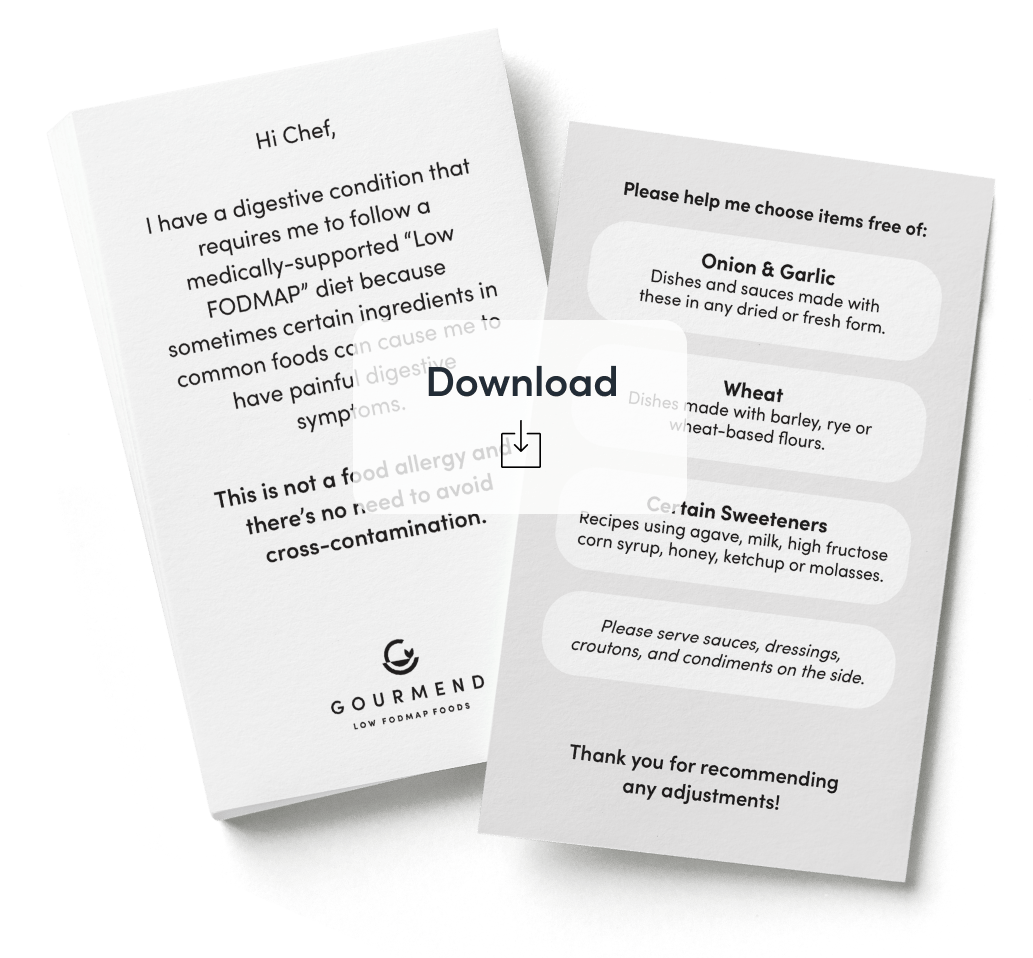
Traveling for vacation or a business trip?
Pack your FODMAP-Friendly Dining Card and non-perishable low-FODMAP foods for on the go snacking, including:
- Low-FODMAP nuts and seeds
- Gluten, garlic & onion-free bars, pretzels, and cereals
- Plain chips (corn or potato)
- Plain popcorn
- Plain rice cakes
- Individual packets of peanut butter
- Single-serve packets of Chicken Bone Broth Powder — a hot cup anywhere there’s hot water

Going to a party or cookout?
Even if it isn't a potluck, you can ask the host if you can prepare a few low-FODMAP dishes to share. The other guests might be surprised to find that FODMAP-friendly food can be so delicious!
Even low-FODMAP alcoholic beverages can aggravate the digestive tract, so stick to the Monash University low FODMAP Diet App’s recommended portions for wine, beer, gin, and vodka.
Gastrointestinal symptoms may make going out to eat or attending a party stressful. But one of the best things you can do to calm your gut other than stick to your low-FODMAP diet is to relax.
Part 11 Advice & Support
This chapter will provide you with resources to make the process easier, including:
- Facebook groups and apps offering support for those of us living low FODMAP
- Sources of helpful information and advice, such as diet professionals’ books and blogs
- Additional online support, diet plans, and recipes from nutrition experts
Following a low-FODMAP diet may seem overwhelming, but remember that this is a process. It will take time to heal your gut, identify foods that you are personally sensitive to, and incorporate low FODMAP ingredients into recipes to reclaim your favorite flavors.
The following are some of the diet experts, resources, websites, and books that support a FODMAP-friendly diet:
Registered Dietitians
Gourmend keeps a directory of FODMAP-trained dietitians, and Monash University maintains its own list of FODMAP trained dietitians.
More from Gourmend
- Why Low FODMAP — the short version of the case this guide makes, with the research behind it
- Low FODMAP ingredient shopping list
- Low FODMAP alternative swaps
- 57 low FODMAP herbs, spices and seasonings
- Find a FODMAP-trained dietitian
Favorite Blogs
Monash Blog
As the official blog of Monash University, one of the world’s top universities as well as the institution that originated FODMAP research, this blog features posts by research dietitians, chefs, healthcare professionals, and other nutrition experts.
FODMAP Everyday
Highly qualified and experienced RDNs, complementary health practitioners, and recipe developers bring appropriate guidance and information to help readers successfully navigate the journey towards improved health.
A Little Bit Yummy
Find low-FODMAP recipes and resources approved by dietitians. The blog is intended to help others gain symptom control through delicious low-FODMAP meal plans.
Kate Scarlata
Registered dietitian and low-FODMAP diet expert. Her long-running blog “For a Digestive Peace of Mind” wound down in 2025, and its recipes and guidance now live on her main site.
The IBS-Free Digest
Run by Patsy Catsos, a registered dietitian and low FODMAP expert, this blog is full of tips on living with a low-FODMAP diet. It hasn’t been updated since early 2025, but the archive is still worth a look.
Favorite Books
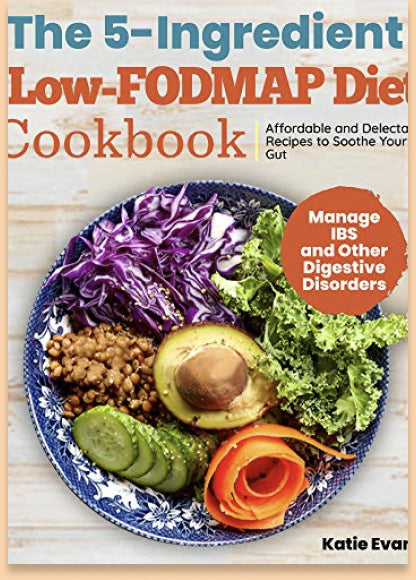

The Flexible FODMAP Diet Cookbook — Laura Manning, RD & Karen Frazier

IBS — Free at Last! — Patsy Catsos, MS, RD, LD

The FODMAP Friendly Kitchen — Emma Hatcher
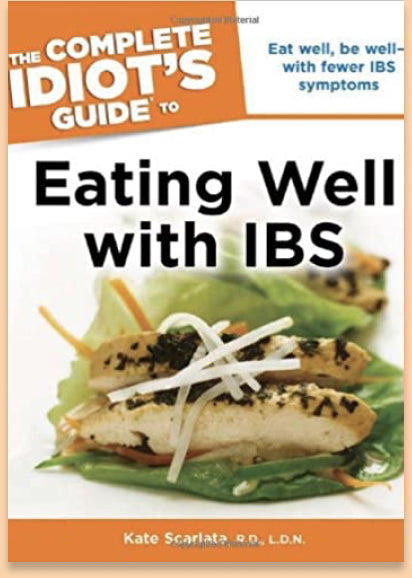
The Complete Idiot’s Guide to Eating Well with IBS — Kate Scarlata, RD, LDN
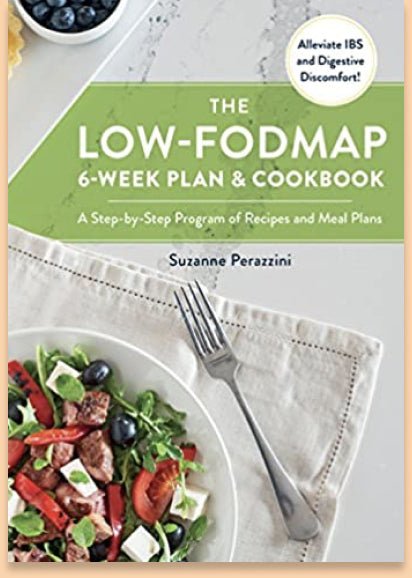
The Low-FODMAP 6-Week Plan & Cookbook — Suzanne Perazzini
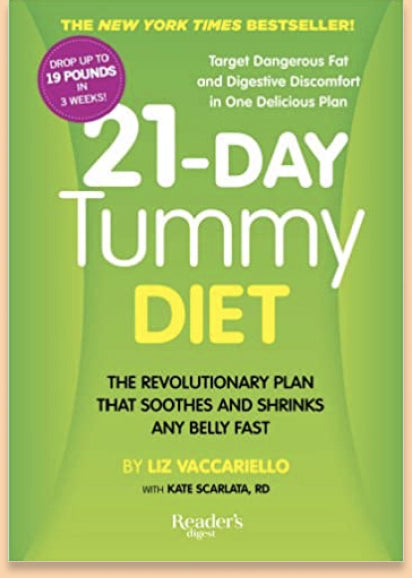
21-Day Tummy Diet — Liz Vaccariello with Kate Scarlata, RD
Facebook Groups


Conclusion
It takes time to learn how to follow a low–FODMAP diet for improved gut health, but it can be done!
With time, creativity, and support, you can eat meals that are nutritious and delicious while limiting high–FODMAP ingredients. You CAN take control of digestive distress and be free to be friends with food again!
- Marsh A, Eslick EM, Eslick GD. Does a diet low in FODMAPs reduce symptoms associated with functional gastrointestinal disorders? A comprehensive systematic review and meta-analysis. Eur J Nutr. 2016 Apr;55(3):897-906. doi: 10.1007/s00394-015-0922-1. Epub 2015 May 17. Review. PubMed PMID: 25982757.
- Zhan YL, Zhan YA, Dai SX. Is a low FODMAP diet beneficial for patients with inflammatory bowel disease? A meta-analysis and systematic review. Clin Nutr. 2018 Feb;37(1):123-129. doi: 10.1016/j.clnu.2017.05.019. Epub 2017 May 24. PubMed PMID: 28587774.
- Ong DK, Mitchell SB, Barrett JS, Shepherd SJ, Irving PM, Biesiekierski JR, Smith S, Gibson PR, Muir JG. Manipulation of dietary short chain carbohydrates alters the pattern of gas production and genesis of symptoms in irritable bowel syndrome. J Gastroenterol Hepatol. 2010 Aug;25(8):1366-73. doi: 10.1111/j.1440-1746.2010.06370.x. PubMed PMID: 20659225.
- Shaukat A, Levitt MD, Taylor BC, MacDonald R, Shamliyan TA, Kane RL, Wilt TJ. Systematic review: effective management strategies for lactose intolerance. Ann Intern Med. 2010 Jun 15;152(12):797-803. doi: 10.7326/0003-4819-152-12-201006150-00241. Epub 2010 Apr 19. Review. PubMed PMID: 20404262.
- Newman, Tim. “What are the benefits of garlic?” medicalnewstoday.com. 18 Aug. 2017.
- "Prevention: Many cases of botulism are preventable." cdc.gov. 7 Jun. 2019.
- De Re V, Magris R, Cannizzaro R. New Insights into the Pathogenesis of Celiac Disease. Front Med (Lausanne). 2017;4:137. doi: 10.3389/fmed.2017.00137. eCollection 2017. Review. PubMed PMID: 28913337; PubMed Central PMCID: PMC5583152.
- Roncoroni L, Bascuñán KA, Doneda L, Scricciolo A, Lombardo V, Branchi F, Ferretti F, Dell'Osso B, Montanari V, Bardella MT, Elli L. A Low FODMAP Gluten-Free Diet Improves Functional Gastrointestinal Disorders and Overall Mental Health of Celiac Disease Patients: A Randomized Controlled Trial. Nutrients. 2018 Aug 4;10(8). doi: 10.3390/nu10081023. PubMed PMID: 30081576; PubMed Central PMCID: PMC6115770.
- Tuck, Caroline, MD. "Sprouting – does it reduce the FODMAP content of foods?". monashfodmap.com. 28 Mar. 2017.
- Verspreet J, Dornez E, Ende W, Delcour J, Courtin, C. "Cereal grain fructans: Structure, variability and potential health effects". Trends in Food Science & Technology. 43(1), 32-42
- Shaukat A, Levitt MD, Taylor BC, MacDonald R, Shamliyan TA, Kane RL, Wilt TJ. Systematic review: effective management strategies for lactose intolerance. Ann Intern Med. 2010 Jun 15;152(12):797-803. doi: 10.7326/0003-4819-152-12-201006150-00241. Epub 2010 Apr 19. Review. PubMed PMID: 20404262.
- Shaukat A, Levitt MD, Taylor BC, MacDonald R, Shamliyan TA, Kane RL, Wilt TJ. Systematic review: effective management strategies for lactose intolerance. Ann Intern Med. 2010 Jun 15;152(12):797-803. doi: 10.7326/0003-4819-152-12-201006150-00241. Epub 2010 Apr 19. Review. PubMed PMID: 20404262.
- Webber, Shirley. "Fermented drinks and the low FODMAP diet". monashfodmap.com. 28 Feb. 2017.
- "Prevention: Many cases of botulism are preventable." cdc.gov. 7 Jun. 2019.